How We Changed the Website and Launched Growth in SEO Leads
Project: dental clinic in Kyiv
Website: dentalart.ua
Industry: dental services
Region: Kyiv, Ukraine
Platform: WordPress
Client Request
The project started as a standard SEO promotion for the dentalart.ua clinic website. Over 10 months of working on organic visibility, it became clear that the site’s potential was limited not by semantics or content, but by the architecture and design of the site itself – even solid keyword and copy work wasn’t producing results within the existing structure.
Більше
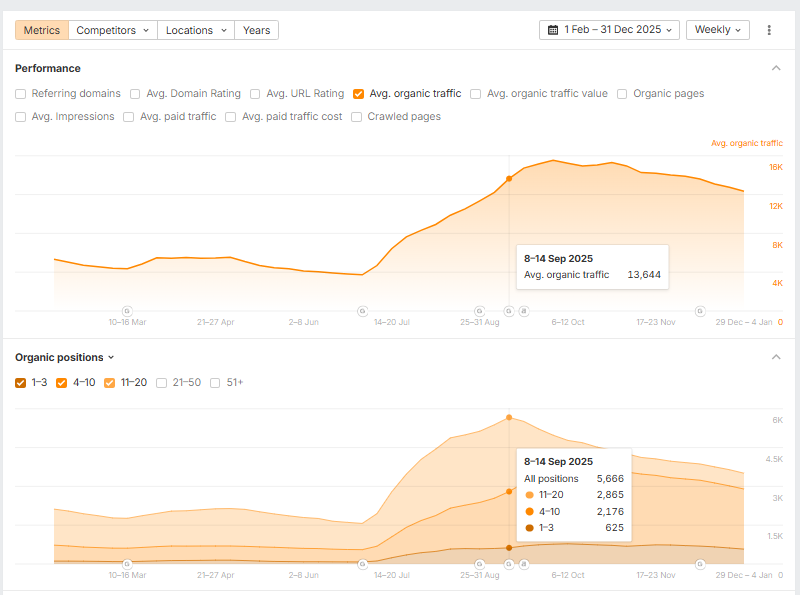
Traffic grew from around 4–5K to a peak of ~16K visits per week, after which it plateaued and started to decline – the old version of the site had reached its ceiling.
The core problem was in the site’s architecture. Commercial pages, which were meant to generate leads, sat three levels deep, while most of the organic traffic went to informational blog articles.

The site had traffic, but a large share of it wasn’t converting into actual patients.
Solution
A technical audit showed that service pages (broad categories like Orthodontics, Implantation, Pediatric Dentistry) lived under /services/, with sub-service pages nested even deeper – and the service pages themselves had been set to noindex before we started working on the project. As a result, only the narrow sub-service pages were being indexed, while the main services – the most commercially valuable pages – stayed out of search results.
This broke the internal linking logic: service pages were meant to pass link equity down to sub-services and form the hierarchy “homepage → service → sub-service.” Under prolonged noindex, Google crawls a page less often and effectively treats its links as nofollow – so services became “dead-end nodes,” and sub-services ended up weakly linked and hidden too deep.
The reason behind that original decision was clear: the service pages were empty navigational placeholders with thin content – no forms, no real text, no trust elements. Instead of improving them, the previous team simply removed them from the index, treating the symptom rather than the cause.
We first tried to fix this within the existing site: removed noindex, opened the pages for indexing, rewrote titles, descriptions and H1s, and added text content. Visibility appeared, but the pages remained low-converting and weaker than competitors’ landing pages – the ceiling of on-page optimization within the old architecture had been reached.
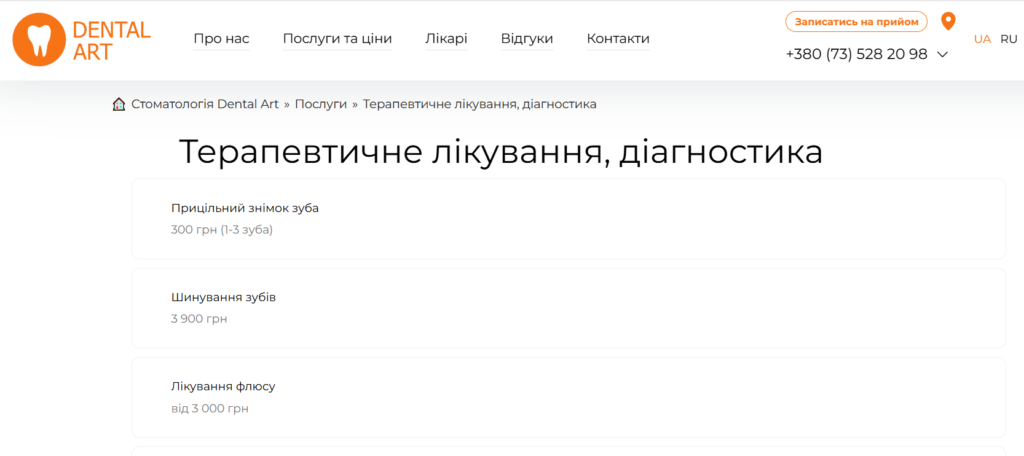
A page like this worked neither for SEO (no text targeting keywords) nor for conversion (almost nothing to prompt a visitor to submit a request).
The audit also revealed keyword cannibalization: overly narrow sub-service pages competed with each other for the same search intent, so none of them ranked consistently. This became the argument for the “one query – one page” principle, which later became the foundation of the new semantic structure.
On top of that, the client was planning to launch paid search campaigns, and the old site didn’t meet current standards for usability or landing-page effectiveness for ads.
Thus, together with the client, we decided not to patch individual elements but to build a completely new site that would solve three tasks at once – SEO, paid traffic, and user experience.
Goals
✅ Reduce the nesting depth of commercial pages and strengthen internal link equity flow ✅ Fix indexing errors: remove noindex, resolve keyword cannibalization
✅ Build a new semantic structure based on the “one query – one page” principle
✅ Build in SEO requirements at the design stage
✅ Strengthen local SEO and E-E-A-T through doctor profile pages
✅ Preserve accumulated traffic and rankings during the site transfer using redirects
Completed Tasks
Building SEO in as the Foundation of the New Architecture
The key difference in this project: the site structure was designed around search demand, not around the design.
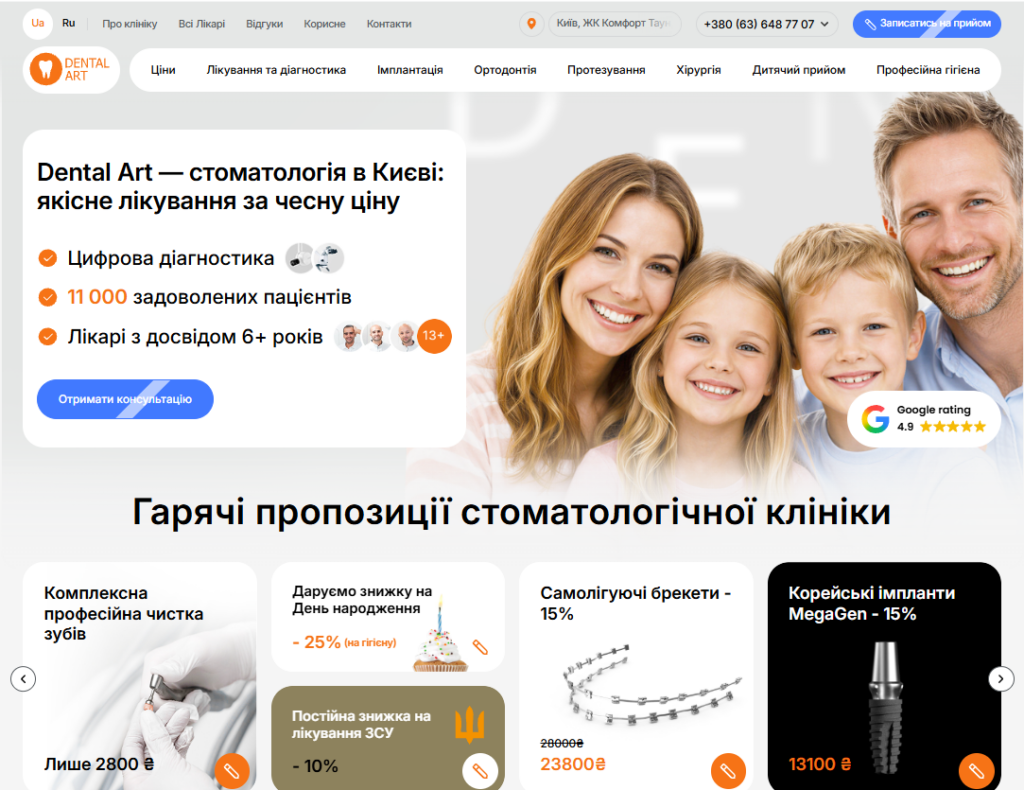
- We reduced the nesting depth of commercial pages – all key treatment areas were moved as close to the homepage as possible. This created a clear hierarchy: Homepage → top level (About the Clinic, Doctors, Services, Prices, Reviews, Blog, Contacts) → Main services → Sub-services.
- We removed the intermediate /services/ segment from URLs, making addresses shorter and cleaner. For every old URL, we set up 301 redirects to the new ones, preserving SEO equity and avoiding 404s.
- We identified priority directions to build the strategy around: root canal treatment, implantation, and orthodontics (including pediatric orthodontics).
Restructuring and Reducing Page Count
Before the rebuild, the site had around 375 pages, roughly 225 of which were informational blog articles.

- We ran a full content audit: clicks/impressions from GSC, current rankings, keyword frequency, competitiveness, and how relevant each service still was. Result of the audit: removed 98 informational blog pages, cut around 36 commercial pages, and regrouped some services (“Pain relief” was folded into relevant treatment areas, “Gnathology” was carved out as a separate consultation under orthodontics).
- We migrated only the highest-performing blog articles based on GSC data; pages with no traffic over the previous 16 months were treated as “dead weight” and left behind – this cleaned up the index without losing any real traffic potential.
- We set up 315 redirects from old pages to relevant new ones, avoiding 404s and preserving SEO equity.
- Services that weren’t carried over as standalone pages were kept “alive” as price line items on the Prices page – the query keeps working for visibility without the cost of maintaining separate content.
Semantic Structure
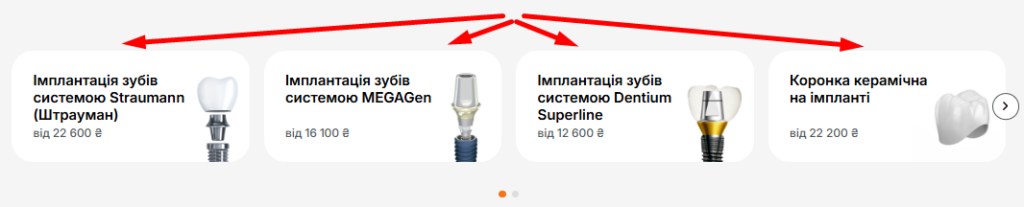
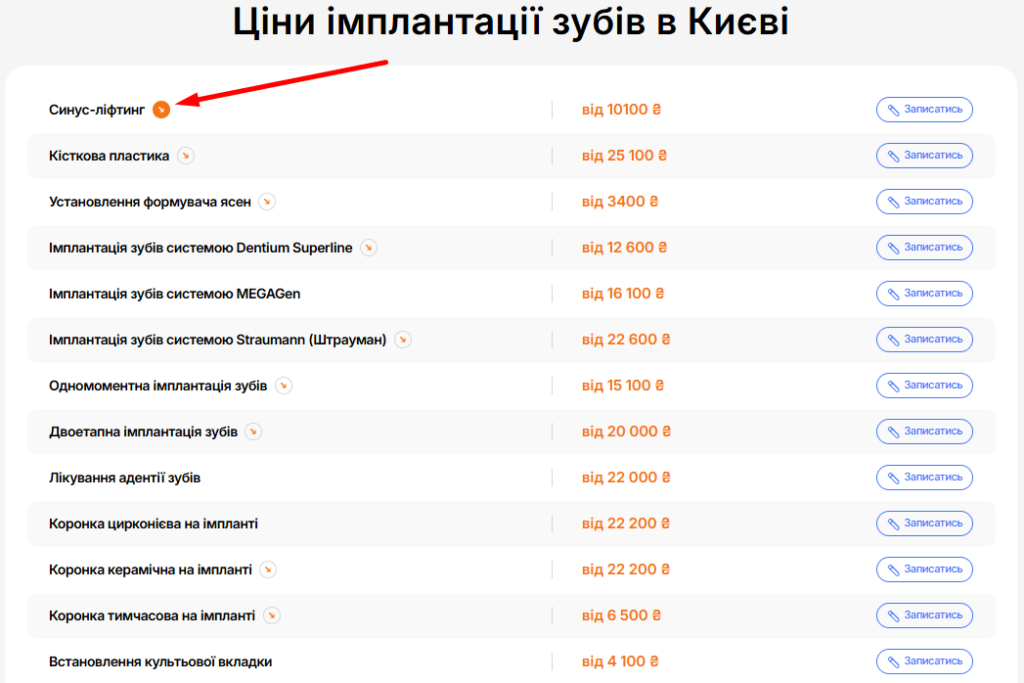
- Each service got its own page, with landing pages built underneath for specific, high-converting queries (for example, “Implantation” → Straumann, MegaGen, sinus lift, bone grafting, zirconium crown, treatment for adentia).
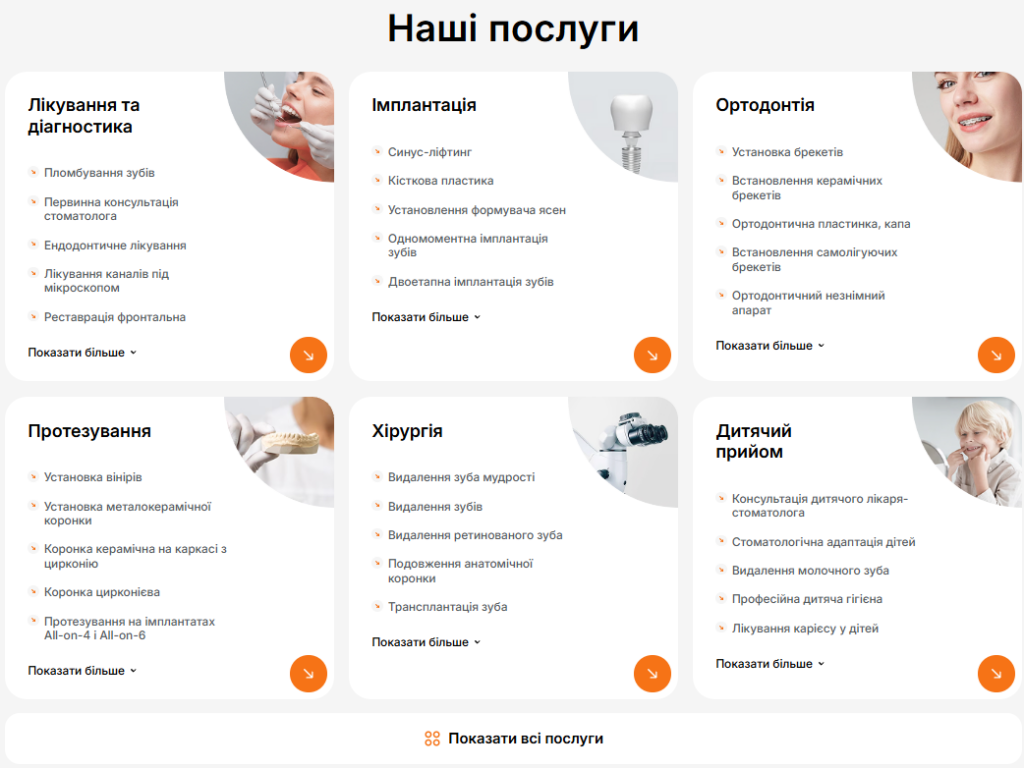
- We distributed semantics from broad to specific: high-frequency queries went to the main service pages, narrower ones to sub-services. This removed internal competition between pages.
Building SEO in at the Design Stage
- The designer worked in close collaboration with the SEO specialist, so every page’s structure accounted for SEO requirements from the start: H1–H4 hierarchy, space for SEO copy, lists, description blocks and content sections.
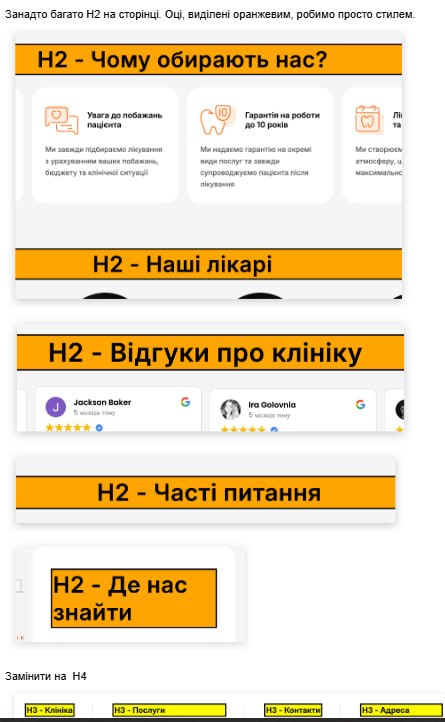
- Almost every page got its own dedicated SEO block for additional keywords that couldn’t be organically worked into the main content.
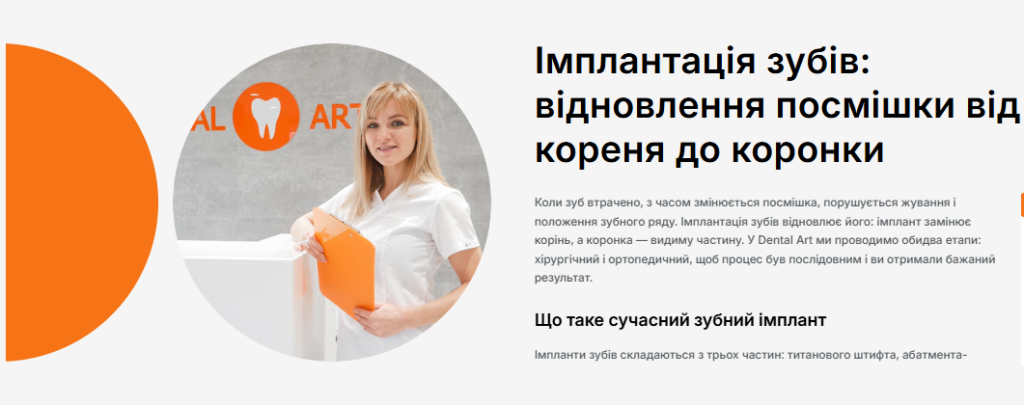
Local SEO and Internal Linking
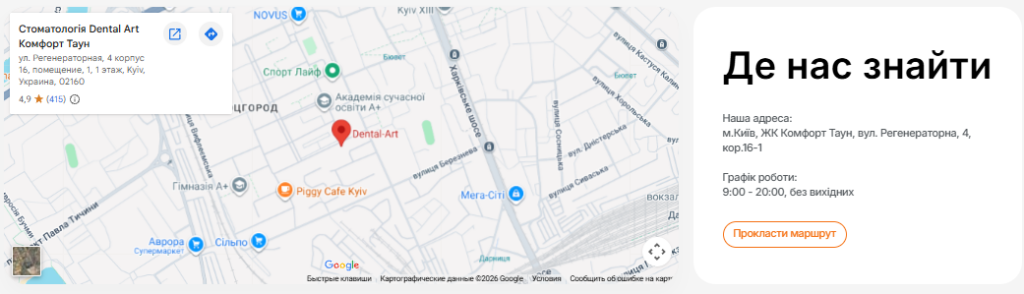
- On commercial pages, we built a contact information block using Kyiv district names, local landmarks, and the kind of phrasing patients actually use when searching for a dentist “near me.”
- Every page got internal links to thematically related services and blog articles – improving indexing and the distribution of internal link equity.
Prices Page and Doctor Pages
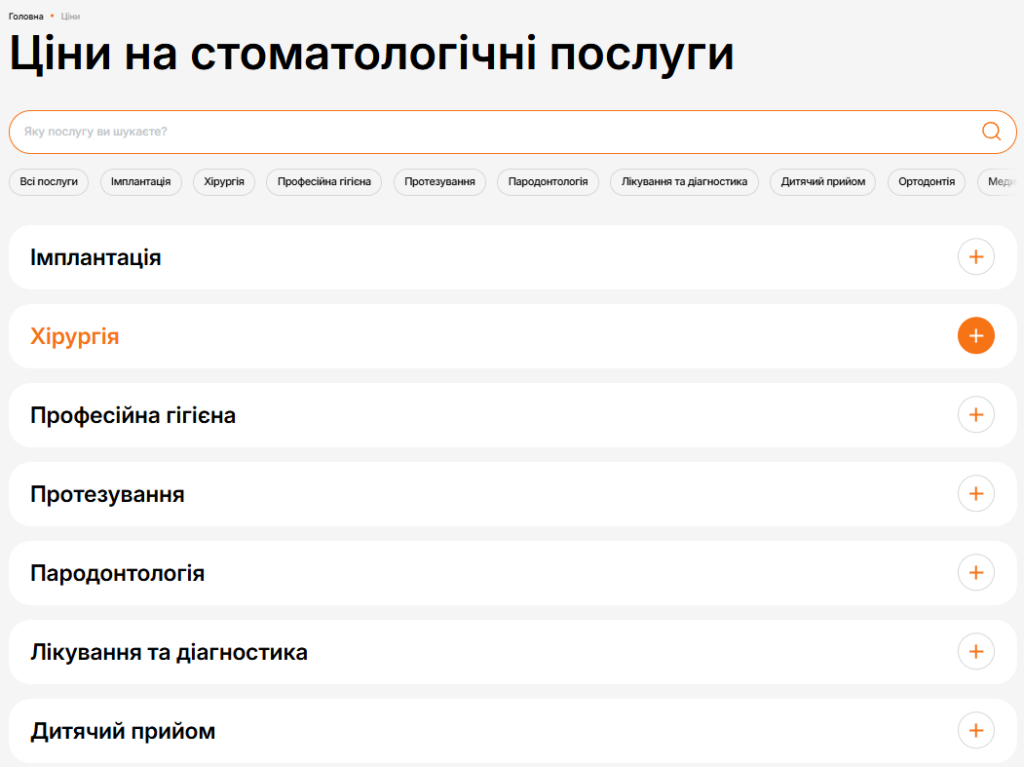
- We built a dedicated Prices page with search and filtering, indexed as its own standalone landing page.
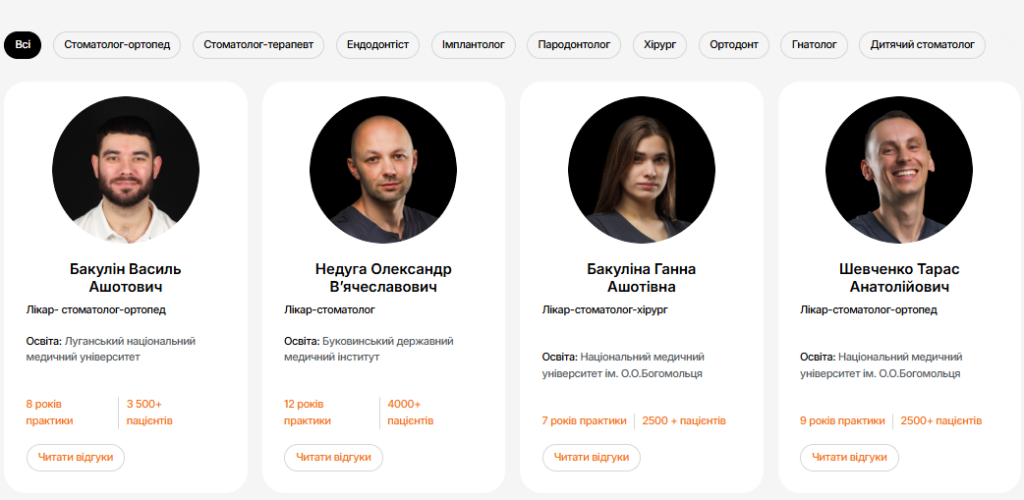
- We created an “All Doctors” page along with individual profile pages for each specialist, covering their experience, qualifications, and certifications.
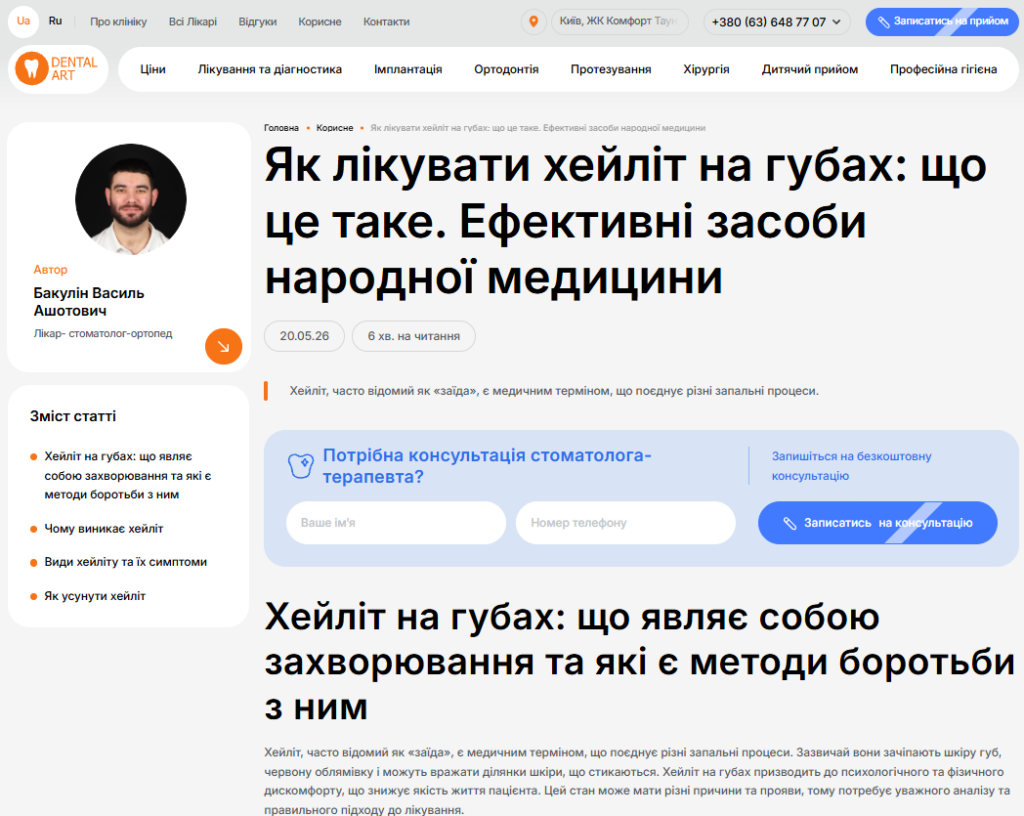
- Each doctor became the author of topical blog articles – content was built around E-E-A-T principles.
Doctor Expertise and Visibility in AI Search
- A deliberate push into AI search (GEO/AEO). Dentistry falls under the YMYL category, where search engines and AI systems (AI Overviews, AI Mode, ChatGPT, Perplexity) hold sources to the highest standard of trustworthiness. Doctor profile pages, article authorship, and schema.org markup work not just for rankings, but toward making the site a source AI systems actually cite in their answers.
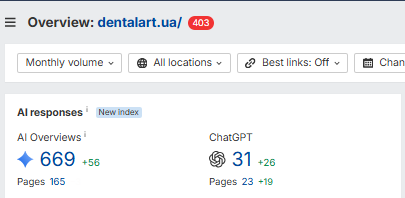
Despite the design update being so recent, the site has already picked up 661 mentions in AI Overviews (+66) across 165 pages, and 30 mentions in ChatGPT (+25) across 23 pages.
Results
The new site amounted to a complete rebuild of the clinic’s digital platform:
✅ ranks effectively in organic search
✅ supports the launch of paid advertising
✅ delivers a strong user experience
✅ can scale without needing major changes down the line
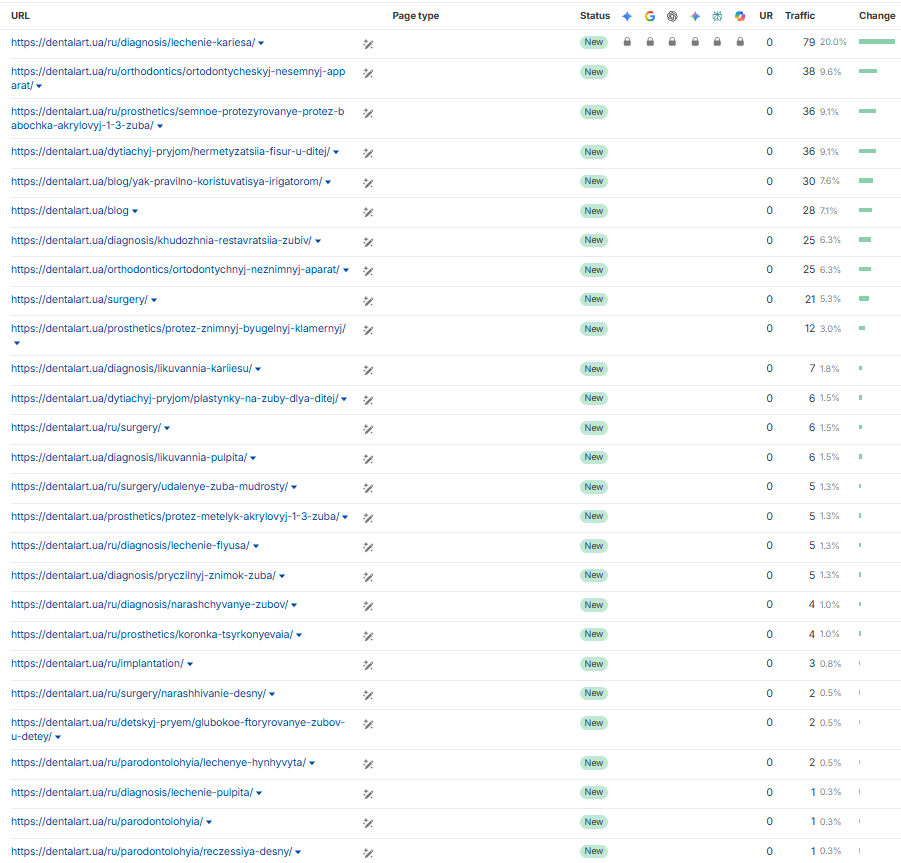
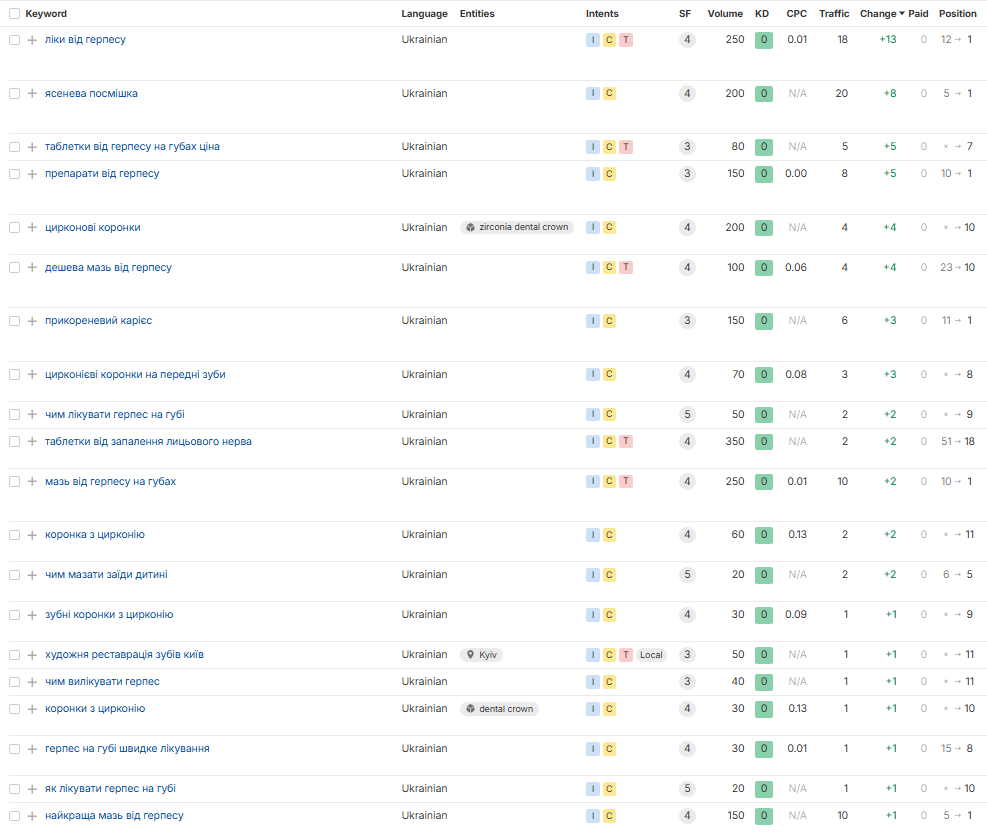
After the design and structure update, new pages started appearing in organic search – mostly commercial ones: prosthetics, orthodontics, surgery, pediatric dentistry, diagnostics. Previously, the blog dominated the top rankings, driving traffic but converting poorly – now the focus is shifting toward services.
Conclusions
The DentalArt case shows: having leads on a site doesn’t always mean they match the volume of potential conversions. In situations like this, the cause isn’t always semantics or copy – it’s often the site’s architecture. Simply growing the blog and traffic further would have been the easiest path, but not a professional one: it would have brought even more visits at the same disproportionately low lead rate.
Instead, the right move is to restructure the site so that commercial pages get the link equity, shallow nesting, and visibility that match their real potential to attract patients. And that needs to happen at the design stage, when SEO is built into the layout alongside the design – not bolted on afterward.
This approach let us raise commercial pages within the structure, prepare the site for paid advertising, and lay the groundwork for AI search visibility through doctor expertise and structured data – all at the same time.
The LuxSite team is grateful to the client for their openness and willingness to make these changes. Deciding to rebuild a site from scratch isn’t just a cosmetic fix – it takes significant resources and time, and we appreciate the trust DentalArt placed in taking that step.