Organic SEO and AI-search optimization for khobzei.clinic
Project: Khobzei Clinic – the clinic of Dr. Kuzma Khobzei
Website: https://khobzei.clinic/
Industry: Healthcare: trichology, FUE hair transplantation, dermatology
Region: Ukraine (core demand – Kyiv), UA + RU versions
Platforms: WordPress (custom theme), GTM, GA4
The client’s starting point:
Khobzei Clinic is a specialized trichology center with strong offline expertise: FotoFinder digital trichoscopy, no-scar FUE hair transplantation and a well-known chief physician. In search, however, that expertise wasn’t working for the brand – patients looking for a trichologist were ending up with competitors.
Our audit uncovered four critical problems:
- Competitors were intercepting branded traffic. The haircheck.online service was running aggressive PPC campaigns, including on the chief physician’s full name.
- Weak non-branded visibility. Priority commercial queries such as “trichologist Kyiv”, “hair transplant” and “trichologist doctor Kyiv” ranked far outside the top 10.
- A highly competitive market. In “trichologist consultation”, the clinic competes with large hospital networks (dobrobut.com) and long-established players (euroderm.com.ua, dermspace.clinic, hairhelp.com.ua). In “hair transplant”, it faces clinics investing heavily in paid traffic, SEO and social media (mck.com.ua, gryshai.clinic, mhtclinics.com, anacosma.com.ua, hairglobalmedik.com, hairmed.center).
- Technical and structural issues. An outdated structure with no conversion blocks, an unoptimized URL structure, a UA/RU version conflict and a site that wasn’t ready to be crawled by AI bots.
Goals:
✅ Grow targeted organic traffic from search engines
✅ Attract new patients unfamiliar with the brand, with a focus on non-branded demand
✅ Rank the “trichologist consultation” and “hair transplant” services in the top for non-branded commercial queries
✅ Stand out from competitors with large ad budgets
✅ Establish Khobzei Clinic as a trusted source of medical expertise – in classic search results and in AI assistant answers
✅ Build a foundation of domain authority for long-term growth
Tasks:
✅ Run a full content audit and build an optimization strategy that meets medical content requirements (E-E-A-T/YMYL)
✅ Rebuild the keyword set with a focus on non-branded commercial queries
✅ Resolve the UA/RU version conflict and tidy up site structure and internal linking
✅ Redesign the website: new structure and conversion-focused SEO blocks on the homepage, header, footer and service pages
✅ Rework the URL structure to match the new logic
✅ Build a link-building strategy for the medical niche
✅ Audit the competitive landscape
✅ Prepare the site technically and content-wise to be cited in AI search
✅ Upgrade the blog: citation-ready blocks, FAQ with structured data, last-updated dates and view counters
Більше
Solution:
Instead of the usual keyword-and-backlink grind, we went deep. We redesigned the website with a new structure, conversion-focused SEO blocks on the homepage, header, footer and service pages and an updated URL structure – boosting conversion and relevance at the same time. We cleaned up the keyword set: removed duplicate and off-target pages, fixed canonical and hreflang tags between the UA and RU versions, and shifted priority to non-branded queries such as “trichologist Kyiv” and “hair transplant”. We also published transparent pricing on a dedicated page and as a PDF – it removes the main objection to an expensive medical service and ranks in search on its own.
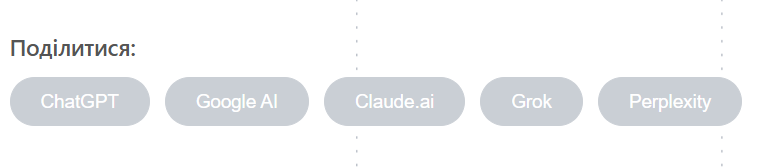
In parallel, we prepared the site for AI search: structured blog articles (for example, “Myths About Hair Transplantation”), FAQ blocks with schema.org markup on the blog, homepage and service pages, share-to-AI buttons for ChatGPT, Google AI, Claude.ai, Grok and Perplexity and sitemap.xml and robots.txt configured for AI crawlers. The link profile was built on relevant medical platforms, doctor directories, media mentions and moderated review sites.
Results:
Over 6 months (February – September 2026), the site went from weak non-branded visibility to rising rankings in priority service areas and its first significant, measurable results in AI search.
Traffic performance
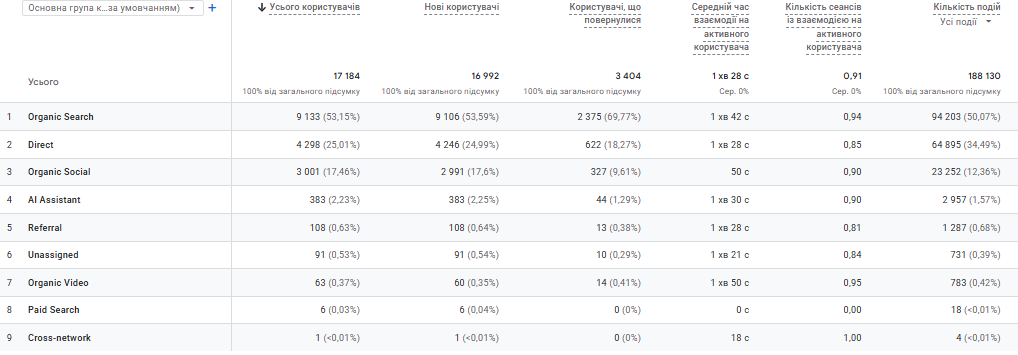
From February to September 2026, organic traffic grew from 1,016 to 1,373 users (+35%). Organic Search remains the main acquisition channel, bringing in almost half (49.55%) of all site users – the vast majority of them new visitors (1,257 out of 1,373).
The AI Assistant channel deserves a special mention. It is already among the top 4 traffic sources (141 users, 5.09%), and its engagement is even higher than the site average: 1 min 39 s of average engagement time versus 1 min 23 s overall, with 0.93 sessions per user. In other words, AI-referred visitors aren’t random – they spend more time on the site than the average visitor.
Traffic from AI assistants (September 2026)
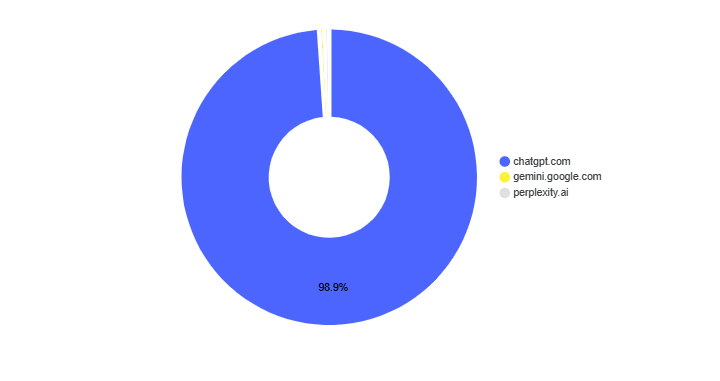


AI traffic is growing explosively: total users from AI assistants rose by 166.1% (to 149) and sessions by 165.2% (to 175). ChatGPT is the clear leader of the channel, accounting for 94.3% of all AI traffic (145 users, +163.6%). A new source – Gemini (gemini.google.com) – has appeared that wasn’t in the data before, while Perplexity and Claude.ai maintain a steady presence.
This confirms that the AI channel isn’t just working – it’s scaling fast. A 2.6x increase over the period shows that preparing the site for generative search (structured FAQs, schema markup, LLM-friendly content formats) delivers an effect that compounds over time rather than fading.
Compared with February – March 2026
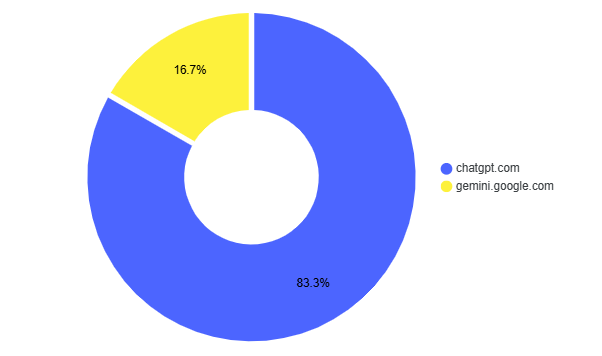


When we started (February – March 2026), the AI channel barely existed: just 16 users and 18 sessions for the whole month. ChatGPT already accounted for most of it (83.3%), while Gemini appeared only in a handful of sessions (16.7%).
In six months the channel grew almost 10x – from 16 to 149 users. This wasn’t a one-off spike but the result of consistent work: the site went from near-invisible in generative search to a steady source of new visitors that keeps accelerating month after month.
How we prepared the site for AI search
The site is technically and editorially ready to appear in AI answers (ChatGPT, Gemini, Perplexity, Claude.ai):
- We built dedicated blocks with clear answers to user questions, so AI assistants can easily read the content as a primary source, and added last-updated dates and view counts to articles.

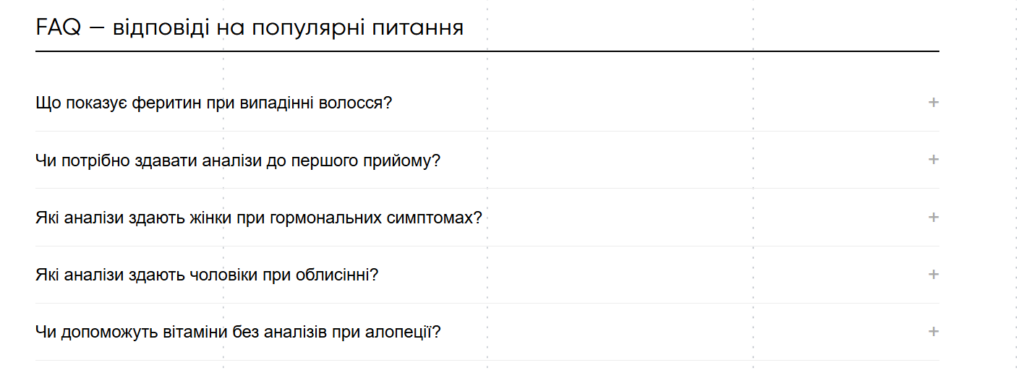
- We created structured Q&A (FAQ) blocks with schema.org markup on blog pages, the homepage and service pages, which strengthened the site’s authority in the eyes of algorithms.
- We added buttons for sharing content directly to AI assistants – a direct signal of engagement with AI channels.
Betting on the AI channel from day one in February 2026 let the clinic get ahead of competitors in the shift to generative search. While other players in the niche still focus only on classic rankings, Khobzei Clinic is already getting a steady flow of visitors from ChatGPT, Perplexity and Gemini – a channel that grew almost tenfold in six months.
Keyword ranking growth:
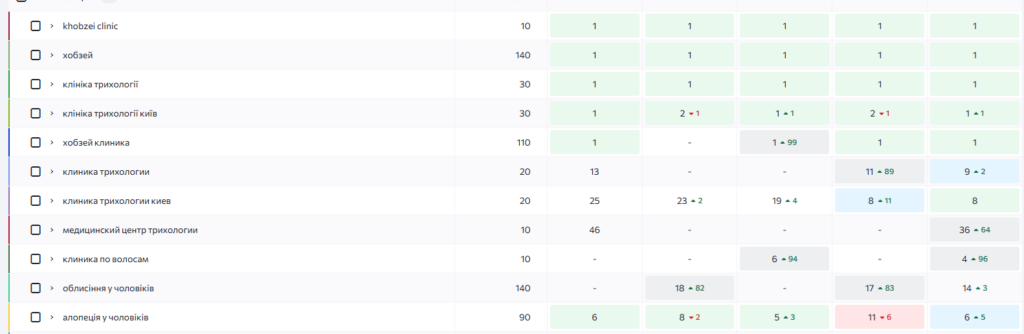
Over six months (March – August 2026), the average position across the core keyword set improved from 44 to 37 – and much more for many commercial queries.
Query highlights:
Rankings are tracked for Ukrainian-language queries; English translations are shown below.
- “androgenetic alopecia in men” – from #46 to #8
- “alopecia treatment for men” – from #26 to #4
- “scarring alopecia” – holding steady at #2
- “alopecia in men” – from #18 to #4
- “trichoscopy Kyiv” – from not ranking to a stable #16–22
The key insight: the new URLs launched after the redesign are growing faster than the old ones. That’s direct proof that restructuring the site and moving to the new architecture delivered a tangible SEO effect. Entirely new service areas also started ranking – for example, “mole removal Kyiv” (straight into #16) and “psoriasis treatment” (#18).
6-month traffic trend
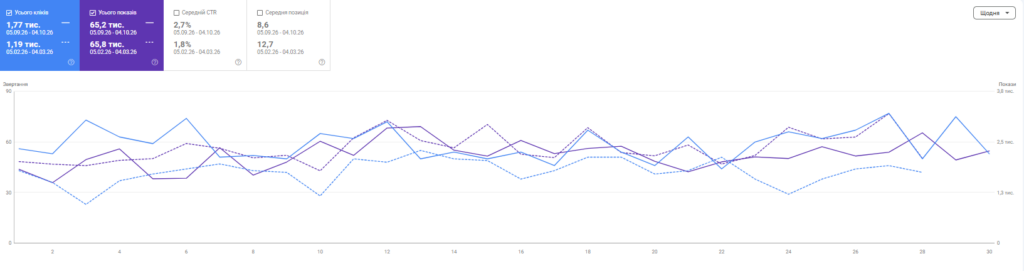
Over six months (February – August 2026), search clicks grew by 27.6% (from 1.23K to 1.57K), CTR nearly doubled – from 1.8% to 3%, and the average position improved from 12.5 to 9.7. Impressions went down – a direct result of the deliberate keyword cleanup: the site dropped off-target queries in favor of more precise ones that actually bring in patients. Less noise in the SERP, more quality traffic.
Conclusion:
The Khobzei Clinic case shows that in the medical niche, the winner isn’t whoever buys the most links, but whoever works deepest on structure, semantics and trust. In six months, khobzei.clinic went from a technical overhaul to a confident position in one of the most competitive medical niches.
An integrated approach – a conversion-focused redesign, a keyword cleanup in favor of non-branded demand and systematic AI-search optimization – delivered real results: +35% organic traffic, nearly double the CTR, commercial queries in the top 4–8, and almost 10x more visitors from AI assistants.
The clinic now earns trust on three levels at once: with patients, with classic search algorithms and in AI assistant answers. The logical next step is to scale this model to related dermatology services.