

“404 error” or “Error 404 Not Found” – this page can appear on any website. During SEO optimization, new content is added to the resource, and old information is updated. If external links pointed to deleted or moved pages, users will see a “404” error instead. Most visitors will then leave the site and look for other resources, without wasting time on unnecessary actions. To bring them back to the portal, you need to make the 404 page so that it transforms from the “Bermuda Triangle,” where clients disappear, into a “trampoline,” from which they will definitely return to the site.
A 404 Error Not Found page appears in the following situations:
- The page being searched has been moved to another address or deleted.
- The server is glitching.
- The site has incorrectly redirected the user to a new page address.
- There is an error in the URL.
- There are broken links.
As we can see, there are many reasons for the appearance of an error. So how do you turn a 404 page from a disadvantage into an advantage?
The 404 page should be designed in the same style as the whole website. Otherwise, users may have questions and doubts about where they are.
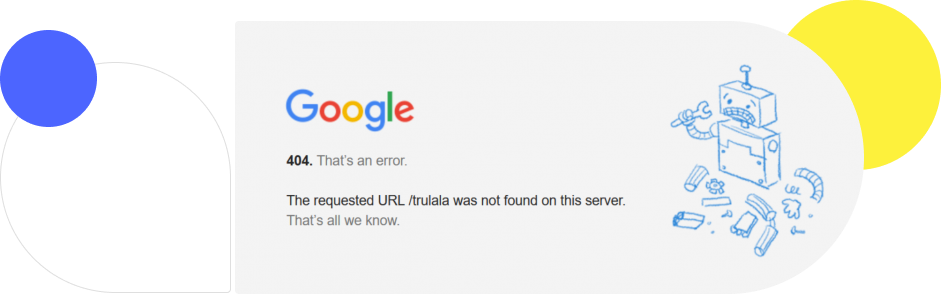
It’s better to make the 404 page interesting and fun to neutralize and reduce the visitor’s irritation. Website owners use various tricks and jokes: writing that the page was eaten by a monster (with a cute monster photo), placing pictures of fictional company employees and offering the user a choice of who to fire for the mistake, or stating that the page did not return from an expedition to the Atacama Desert (a short text on a background of the desert and sun-scorched skeletons)…
Recent research shows that humorous information is better displayed through text, rather than images (which can be accompanied by small funny icons). The percentage of people who return to the website from text-based 404 pages is twice as high as from image-based ones. The reason is simple: users will smile if they see a funny page, but they will still leave the site – because they never understood what happened.
Whatever humorous form you choose, your 404 page should contain factual information that briefly explains the issue and helps users make a decision quickly. The “404” message must indicate that the page doesn’t exist or has been moved. It should also include convenient links to the main sections of the site. Additionally, you could add, for example, a search form for the portal, contact information, or information about current sales, hot offers, and links to popular materials.
How to avoid the 404 error?
Although Google claims that a website’s ranking is not lowered just because it has a few 404 pages, if there are too many of them, the search engine will take it into account. Therefore, if you change or delete many pages on your site at once, you can use code 410 instead of 404 so that the system removes unnecessary documents. Also, when changing the URL structure, make sure to set up a 301 redirect for the pages. To fix broken links, which are also often the cause of the 404 error, use one of the special tools.
- You can find error pages using Yandex Webmaster. Go to “Indexing”, “Pages in Search,” and “Excluded Pages,” then set the “HTTP Error: 404” filter.
- You can also detect the error in Google Search Console. Go to “Crawl” – “Crawl Errors” – “404 Error.”
- Yandex Metrica and Google Analytics can be used by entering the appropriate codes.
Once you identify 404 pages using any of the available methods, fix the links to make them functional. Don’t lose your audience in the “404 Bermuda Triangle,” and turn all the disadvantages of your site into its advantages!