

SEO keeps demonstrating unique resilience among all digital channels. Even during periods of economic turbulence, this segment not only survives but actively grows. The reason is simple: unlike paid advertising, where traffic stops the moment the budget is switched off, SEO generates an organic flow of visitors that accumulates over years. This makes it a strategically vital tool precisely when businesses are looking for ways to reduce dependence on continuous advertising spend.
Ukraine’s SEO Market: Dynamics and Forecasts
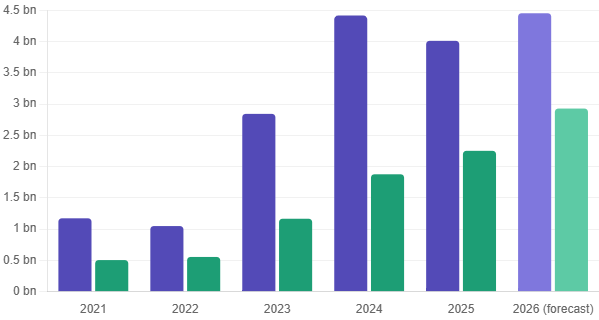
Ukraine’s SEO market has gone through several dramatic phases. In 2022, against the backdrop of the full-scale invasion, the segment contracted. However, 2023 brought a sharp rebound: according to IAB Ukraine, the market grew by 110% – reaching UAH 1.165 billion. In 2024, growth continued with a further 28% increase, hitting UAH 1.876 billion. The forecast for 2025 stood at UAH 2.251 billion – the highest figure among supplementary digital advertising channels, underscoring SEO’s value as a long-term instrument.

The updated IAB Ukraine data published in 2026 shows that the market reached approximately UAH 4 billion in 2025. The 9% market contraction in 2025 is viewed as natural consolidation following a peak in growth, rather than declining demand for SEO. IAB Ukraine forecasts UAH 4.451 billion for 2026 – nearly 11% above the 2025 figure.
According to a separate estimate by the All-Ukrainian Advertising Coalition, SEO reached UAH 2.251 billion in 2025, with the 2026 forecast already at UAH 2.927 billion – a clear signal that businesses are growing tired of full dependence on paid traffic. The variance between sources stems from different methodologies: the narrower estimate includes only core SEO services, while the broader one captures adjacent disciplines (SEO-driven content marketing, link building, technical audits and local SEO).
Regardless of methodology, the trend is unambiguous – the market has grown three years in a row, and business demand for organic visibility continues to intensify.
Ukraine SEO Market Dynamics 2021–2026
The Global SEO Market: Growth in the Billions
Globally, the picture is even larger in scale. Estimates from various analytical agencies vary depending on what is included in the definition of “SEO market” (services, software, or both combined):
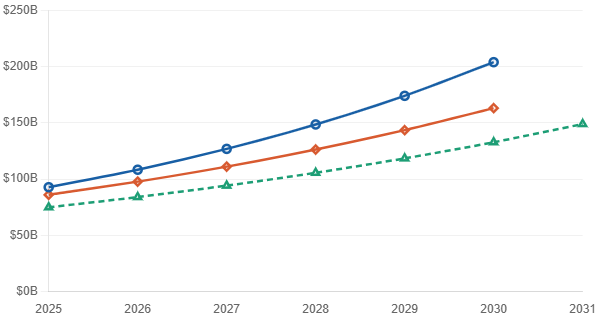
- The SEO services market in 2026 is valued at USD 108.28 billion, up from USD 92.74 billion in 2025 (CAGR 16.8%); by 2030, it is projected to reach USD 203.83 billion.
- According to marketing agency estimates, the SEO services market will stand at USD 83.98 billion in 2026 and reach USD 148.86 billion by 2031 at a CAGR of 12.12%.
- The SEO software market is valued at USD 97.7 billion in 2026, projected to grow to USD 271.9 billion by 2034 at a CAGR of 13.65%.
What drives this growth? The expansion of mobile internet, voice and visual search, the integration of AI and machine learning into SEO, rising investment in content marketing, and the spread of cloud-based SEO tools. Google processes over 8.5 billion search queries every day, holding roughly 90% of the global search market, while organic search generates around 53% of all web traffic.
Global SEO Market Forecast 2025–2031
AI Changes the Rules: GEO, AEO, and the New Search Reality
2026 became a turning point for SEO for one reason – artificial intelligence has transformed how users search for information. Google AI Overviews, ChatGPT Search, Perplexity, Google Gemini, and other services have fundamentally reshaped the user journey from query to answer.
Top SEO trends in 2026 include: zero-click search (approximately 60% of Google searches now end without a click), AI Overviews appearing in 89% of branded search results, the rising importance of E-E-A-T as a trust filter for AI systems, the shift from position-based ranking to multi-surface visibility, and the emergence of Generative Engine Optimization (GEO) and Answer Engine Optimization (AEO) as distinct disciplines.
The Ukrainian market is not on the sidelines of these changes. Current market research highlights that traffic from ChatGPT to Ukrainian online stores increased ninefold over nine months of 2025. This means businesses that previously focused exclusively on Google visibility are now compelled to optimize for LLM responses as well.
Notably, Google itself officially addressed the terminology confusion, stating directly: “From Google Search’s perspective, optimizing for generative AI search is optimizing for the search experience, and therefore still SEO.” AEO and GEO are treated as part of SEO, not separate disciplines. In other words, the foundation remains the same – quality content, technical accessibility, authority – but the requirements for depth and authenticity continue to grow.
As of 2026, 72% of SEO professionals use AI tools such as ChatGPT, SurferSEO, and Jasper for content creation and optimization, while machine learning supports predictive keyword research and content gap analysis.
Classic SEO vs SEO in the Age of AI – A Comparison
| Parameter | Classic SEO | SEO in the AI Epoch |
| Core metric | SERP position, CTR | Multi-surface visibility, AI citations |
| Key behaviour | Click-through to the site | Zero-click – ~60% of queries |
| Content focus | Keywords, text volume | Expertise, first-hand experience, E-E-A-T |
| Traffic channels | Google, Bing | Google + ChatGPT, Perplexity, Gemini |
| Technical basis | Website, sitemap, Core Web Vitals | + Schema, Merchant Center, GBP |
| Tools | Ahrefs, Semrush, GSC | + Otterly.ai, Promptmonitor, Peec AI |
| AI Role | Support tool | 72% of professionals use AI in their workflow |
In May 2026, Google officially defined GEO and AEO as part of SEO, not separate disciplines. The principles remain the same – only the surfaces on which you need to be visible have changed.
ROI: Why Businesses Keep Investing in SEO
ROI figures explain why companies are not cutting SEO budgets even in the AI era – in fact, they are increasing them. SEO generates an average ROI of 702–788% across industries, with original content delivering 66% ROI, content updates returning 42.6%, and technical fixes 42.3%. Around 60% of SEO professionals report organic growth despite AI disruption.
For eCommerce brands, SEO accounts for an average of 44% of total revenue, and pages optimized for intent-based keywords show 32% higher conversion rates. In the context of the Ukrainian market – where paid search exceeded UAH 25 billion in 2025 – SEO emerges as a strategic counterbalance, a way to reduce CPL over the long term. This is why businesses are increasingly investing in professional SEO services as the foundation of a sustainable customer acquisition strategy.

Forecasts: Where SEO Is Heading in 2026–2027
A few key vectors of development worth keeping in mind:
1. The shift from traffic to visibility. The “site clicks” metric is losing its monopoly. It now matters equally whether an AI Overview cites you or whether you appear as a source in a ChatGPT response.
2. E-E-A-T becomes a critical filter. AI systems actively filter sources by experience, expertise, authoritativeness, and trustworthiness. Brands without a clear expert position are dropping out of LLM responses.
3. Local SEO and structured data. For eCommerce and service businesses, Schema markup, Merchant Center, and Google Business Profile become essential – these are the channels that feed AI responses.
4. New reporting metrics. Impressions in AI Overviews, share of citations in generative responses, and multi-surface visibility are beginning to replace or supplement classic SERP positions.
5. The growing role of first-hand content. Generic content that AI can produce on its own is losing value. Materials backed by original research, case studies, and expert interviews are winning out.
Conclusion
SEO in 2026 is not a “dying channel,” as critics were writing just two years ago. It is, rather, a channel undergoing transformation while retaining its core characteristic – stability and long-term ROI. Ukraine’s market has grown three years in a row, and the global market is heading toward USD 200+ billion by 2030. AI is not killing SEO – it is rewriting its rules: the focus is shifting from mechanical ranking to building genuine expert visibility. Businesses that adapt now will gain a competitive edge for the next three to five years.