Link building for niche projects is always a challenge. There are topics where links are a true luxury – like medicine, finance, tobacco, gambling or B2G. The reason lies in the high level of regulation, low audience trust and strict publishing restrictions in these industries. Even unique and high-quality content doesn’t always guarantee backlinks, while standard SEO methods often prove ineffective.
To succeed in such niches, it’s essential to combine creative approaches to finding link donors, thoughtful outreach and strategies to bypass restrictions. In this article, I’ll explore how to work with “difficult” topics, what to consider when selecting link donors and which methods help acquire backlinks even where they are scarce.
Examples from my own professional experience will illustrate which approaches actually work in narrow and highly regulated fields.

Understanding the Specifics of Each Niche
To build links effectively in challenging niches, it’s initially crucial to understand the specifics of each topic – its restrictions and audience psychology.
Medicine & Healthcare: Trust and Legal Barriers
The medical niche requires exceptional caution. Content in this field is often regulated by law and demands high credibility. Even a minor mistake can damage reputation and websites are reluctant to link to external sources without verified information.
For instance, an article about treating a specific condition without scientific citations is unlikely to be accepted by a medical blog or portal. That’s why medical link building often relies on scientific research and reviews, publishing case studies in specialized outlets, collaborating with associations and medical experts and focusing on the trustworthiness of referenced sources.
Finance & Lending: Regulation and Fraud Risk
Financial topics – especially credit, investment, loans and insurance – are under constant regulatory scrutiny. Due to the high risk of fraud and scams, many websites avoid external links to prevent being associated with unreliable content.
From my experience, effective methods include publishing analytical materials, reports and statistics; partnering with reputable financial blogs and fact-checked media; and using expert interviews to enhance credibility.
Gambling: Strict Content Restrictions
The gambling niche is one of the toughest in terms of link building. Many media outlets and blogs outright refuse to link to gambling content and advertising restrictions make direct outreach nearly impossible.
Here, indirect promotion methods work best – such as content related to strategies or market statistics without direct CTAs, thematic reviews, analytical pieces, infographics and studies that can be shared even on strict platforms.
Tobacco, Hookahs & Vapes: “Gray-Area” Marketing
Promoting websites in the tobacco or hookah sector faces unique barriers. Major platforms (Google, Meta, large media outlets) strictly prohibit advertising or content related to tobacco, making classic link building and outreach difficult to apply.
The solution lies in using adjacent topics: hookah culture, the history of tobacco, accessory reviews, local lifestyle media, leisure magazines, UGC platforms and forums where users share experiences – as well as partnerships with restaurants, bars and themed events.
The key is to focus on neutral and culturally styled content rather than direct promotion, allowing for natural backlinks even in heavily regulated fields.
B2G & Government-Related Topics: Limited Donor Opportunities
B2G (Business-to-Government) projects frequently involve working with official or municipal portals where publishing is highly regulated. Traditional outreach to blogs or media usually doesn’t work and the number of relevant donors is limited.
In such cases, link building can rely on publishing content through partner or associated platforms, case studies, analytical reviews for professional audiences and participation in conferences or webinars followed by publication of materials.
Conclusion: Why Standard Link Building Methods Don’t Work
Typical approaches such as mass guest posting or buying links on blogs rarely work in these niches because of:
- strict requirements for credibility and legal compliance;
- low trust of websites toward external sources;
- a limited number of relevant and authoritative donors.

Success in “difficult” niches requires a blend of analytical thinking, creativity, and strong strategic planning. When these elements are combined, even the most regulated or sensitive topics can offer opportunities for building valuable, trustworthy backlinks.
Finding Relevant Link Donors in “Difficult” Niches
It’s not easy to find resources for link placement in highly regulated niches. That’s why it’s important to approach donor research systematically and use non-standard methods.
Competitor and Industry Leader Analysis
The first step is to study where your competitors are already getting their backlinks. Personally I, use tools like Ahrefs or Semrush to identify:
- which websites link to competitors;
- which content attracts the most backlinks;
- which referring domains appear most frequently.
This allows me to create a list of potential donors and understand what content formats work best in a specific niche. For example, in industries like tobacco or hookahs, it’s essential to avoid direct advertising and instead focus on research pieces, reviews, or historical content. This approach significantly reduces the risk of rejection and helps the donor see informational rather than promotional value in your article.
Using Professional Associations, Communities and Forums
In “difficult” niches, an approach I call “expert networking” often works best. This involves:
- Leveraging professional associations and industry communities that operate authoritative, high-trust websites;
- Engaging in thematic forums or LinkedIn groups to connect with experts willing to share content or collaborations.
For instance, in the medical niche, valuable placements can come from publications in doctors’ associations or specialized conference websites – they offer far more trust and authority than regular blogs. You can also target associated medical portals, professional blogs run by doctors, or scientific journals. Instead of promoting an article about treating a specific condition, you can prepare a research piece or an overview of treatment methods and publish it on a medical association’s website.
Discovering Relevant Blogs and Media via Semantic Clustering
Another effective method is semantic clustering of keywords and topics. It helps identify websites that are contextually relevant to your niche, potentially open to link placements and have audiences genuinely interested in your subject matter.
For example, in the gambling niche, instead of targeting direct casino reviews (which are often prohibited), you can find blogs focusing on market analytics, player psychology or industry statistics. These topics make it possible to gain backlinks legally and without violating content restrictions.
Outreach in Low-Trust Niches
In highly regulated niches, even finding potential donors doesn’t guarantee results. The main challenge lies in low trust – website owners carefully vet every piece of content and direct link requests are often ignored. That’s why outreach in such niches isn’t just about sending emails – it’s a comprehensive trust-building and value-creation strategy.

Creating Value for Donors: Expert Content, Research and Case Studies
First and foremost, you need to earn the backlink. In low-trust niches, the following approaches work best:
- Expert content – articles, reviews, and research supported by data or authoritative sources.
- Case studies and practical examples – detailed success stories that demonstrate real results or innovations.
- Research and analytics – unique data or infographics that attract attention and encourage sharing.
For example, in the finance niche, instead of presenting a plain product description, you can prepare a market overview or comparison chart of financial tools, which a relevant portal would be happy to publish due to its informational value.
Personalized Emails: Tone, Structure and Avoiding Templates
From my experience, standard outreach templates are often ignored – especially in “difficult” topics. The key to success is personalization: addressing the recipient by name; referencing a specific piece of content on their website; clearly explaining why your content is valuable to their audience; providing a clear, actionable proposal – such as adding a link, publishing a joint case study, or doing an interview.
The tone should be professional yet friendly – it’s important to show that you’re offering real value, not just trying to promote your own site.
Building Trust Through Micro-Interactions: Comments, Conferences, LinkedIn
Sometimes, direct outreach works only after prior “warming up” interactions. These can include commenting on professional blogs; participating in industry conferences and webinars; engaging in LinkedIn groups or niche communities.
Such micro-interactions help establish recognition and trust. When you finally send your outreach proposal, the site owner already knows who you are – and is much more likely to consider your request seriously.
Methods for Overcoming Restrictions
In my practice, niches with strict regulations and low trust often make direct link building nearly impossible. In such cases, creative approaches and PR-driven strategies work far better, allowing you to earn backlinks even where traditional methods fail.
Using PR Approaches: Publishing in Specialized Media
Publications in industry-specific media and niche portals often accept content that wouldn’t fit mainstream blogs – such as market overviews, case studies, expert commentary or research reports.
For example, in the medical niche these are publications on association or healthcare organization websites, while in finance this implies sharing insights on analytical portals or investor-focused magazines.
These backlinks are especially valuable because they’re authoritative, relevant, and high-trust.
Infographics and Research as “Link Magnets”
Visual content and unique research pieces often act as link magnets. A well-designed infographic or analytics report spreads easily among bloggers and media – even in “difficult” industries.
Here are a few examples. In finance, an infographic showing the popularity of different investment tools, while in gambling, statistical reports about player behavior patterns with no direct calls to action or promotional content.
Content Partnerships and Joint Case Studies
Collaborating with other companies or experts can help bypass direct link restrictions. Joint initiatives like co-branded case studies, collaborative research, guest article series or partnerships with associations generate valuable, natural backlinks.
Because this type of content delivers real value and expertise, it’s often shared organically, reinforcing both authority and visibility.
Guest Posts in Indirect but Relevant Topics
When direct link building isn’t an option, it’s worth targeting adjacent niches where content remains contextually relevant but doesn’t violate restrictions.
For instance:
- In gambling, contribute to blogs about risk psychology or market analytics;
- In medicine, publish on wellness or science-related portals;
- In finance, target economic magazines or entrepreneur platforms.
Such indirect guest publications allow you to secure backlinks legally and ethically while expanding your content visibility within related audiences.

KPI and Performance Evaluation
In niche and highly regulated industries, measuring link-building success is more complex than in mass-market blogs or e-commerce. Here, what truly matters is not just the number of backlinks, but their quality, relevance and impact on site authority.
Key Metrics for Niche Projects
The main KPIs include:
- Domain Rating (DR) or Authority Score of referring domains – backlinks should come from authoritative websites, even if there are only a few of them. The minimum acceptable DR is 30+.
- Content Relevance – links must appear on pages that are thematically aligned with your project.
- Traffic and Visibility – growth in organic traffic following link placements. Ideally, the donor site should have 5,000+ monthly visitors, ensuring that the link carries real value and visibility.
- Natural Link Profile – diversity of donors, anchor text variety, and a steady, natural backlink growth pattern without sudden spikes.
In niche industries, one high-quality donor often brings more value than dozens of weak ones.
Balancing Link Quantity and Quality
In narrow niches, attempting to build link volume too quickly can backfire – sites may reject your requests, and your backlink profile may appear unnatural. The main principle here is quality over quantity. I focus on authoritative and relevant donors, use a mix of link formats (anchor, non-anchor, branded) and maintain a natural profile that aligns with industry standards and guidelines.
Tracking Long-Term Results
With over 7 years of experience, I can say that niche link building is a long-term strategy – one that delivers results gradually. It’s important to regularly monitor how backlinks influence site rankings and organic traffic, assess audience engagement with linked content and adjust your outreach and content strategies based on performance data.
The right balance of strategic metrics, quality focus and ongoing optimization not only helps secure valuable backlinks but also strengthens trust, authority and credibility within your niche.
Successful Case Studies
To demonstrate how the described approaches work in practice, I’ll share several case studies from my personal experience at LuxSite.
Case 1. Medicine: Competitor Analysis and Niche Platforms
Challenge.
The medical field is one of the most highly regulated industries. Publications on general-interest websites often fail to deliver the desired effect, while specialized media are cautious about featuring third-party content.
Solution.
For clients in the medical niche (CSM – Brain Stimulation Center, Maestro Medical – medical equipment, Dental Art – dentistry), we conducted an in-depth competitor analysis and extracted backlink data specifically from the medical segment.
This helped us identify:
- local catalogs and medical directories;
- professional forums and communities;
- niche health-related websites and portals.
Based on the collected data, we developed a tailored link-building strategy focused on relevant resources. Additionally, expert-level publications were prepared for health and medical platforms.
Result.
- Placement on websites of medical associations and professional blogs;
- Acquisition of high-quality backlinks;
- Growth in organic traffic and overall domain authority.
Have a look at a few specific examples below.
Dental Art
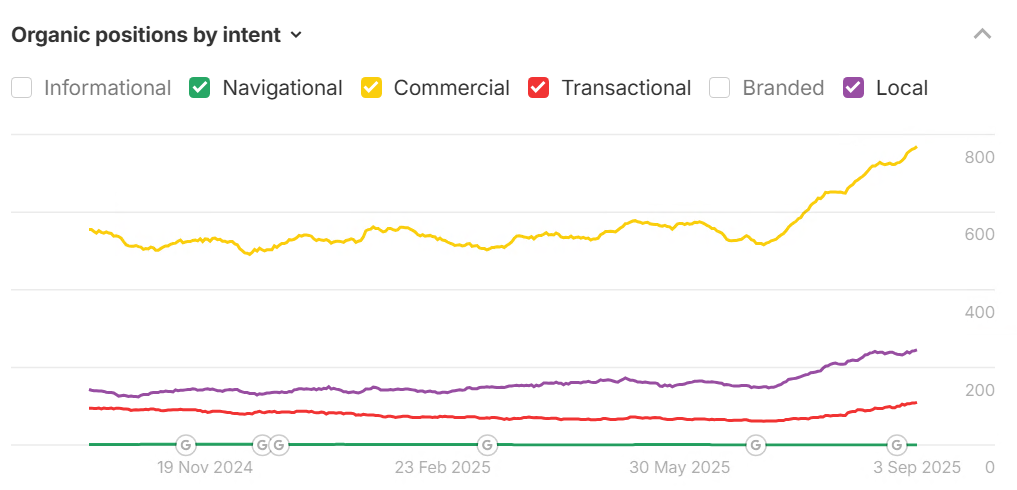
The client approached us in November 2024 with the goal of increasing the number of commercial keywords and improving their rankings. While informational queries consistently ranked in the top positions and generated substantial traffic, commercial keywords were barely visible in search results.
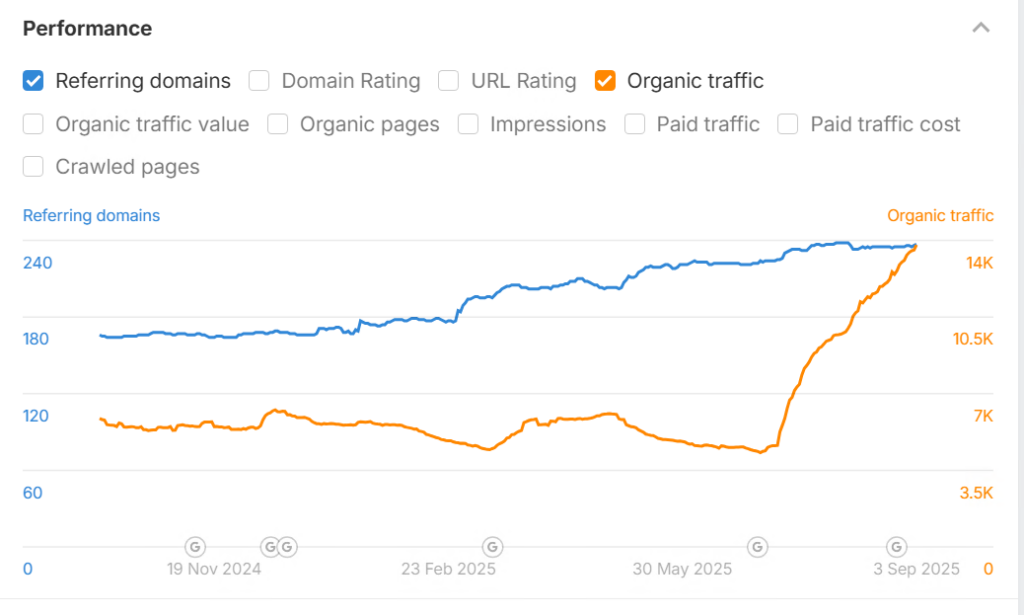
Thanks to systematic link-building with high-quality backlinks, on-site optimization and placements on niche-relevant platforms, by early summer 2025 we observed a significant increase in both organic traffic and the number of commercial keywords ranking in search results.
Maestro Medical
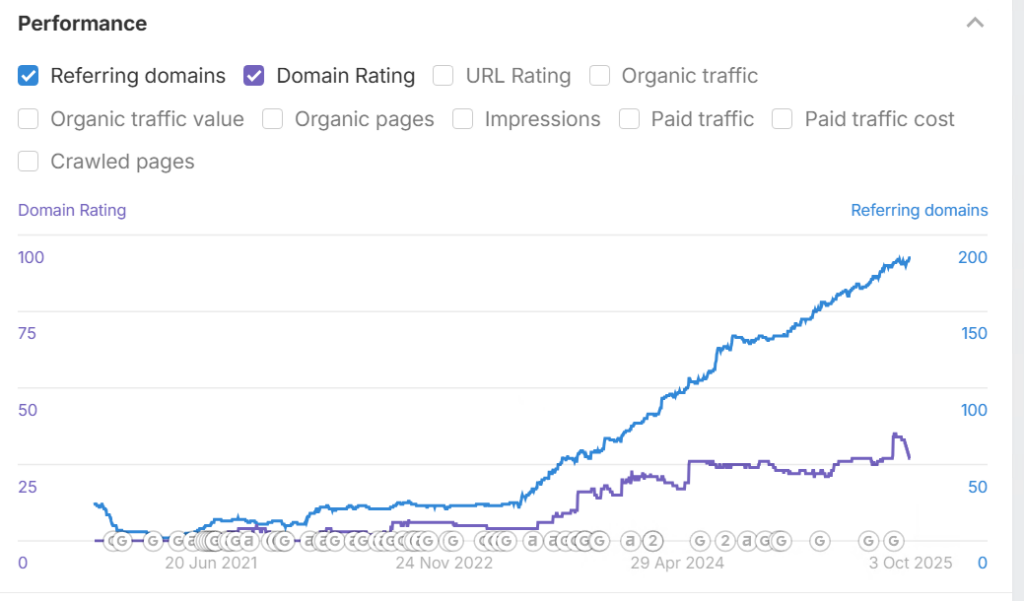
This case clearly demonstrates the correlation between the Domain Rating (DR) and the number of referring domains. The number of quality backlinks steadily increased, which had a positive impact on DR growth – from a minimal value of 3 to over 30 by October 2025. A high DR indicates that the website has a strong backlink profile, which can be perceived by Google as a sign of trust and authority within its niche.
Conclusion
Even in a strictly regulated medical field, it is possible to gain high-quality backlinks if the content provides expert value and is published on carefully selected, relevant platforms.
Case 2. Tobacco/Hookahs: A “Gray” Niche Requiring Careful Approach
Challenge.
The hookah and tobacco niche is legally regulated and falls into a “gray area.” Official advertising is prohibited and most major media avoid collaboration with such brands. For the hookah e-commerce store DUMOK, it was necessary to find a way to acquire natural backlinks without the risk of account or content blocks.
Solution.
After conducting a competitor analysis, we collected backlink data which formed the basis for a practical link-building strategy. The main focus was on:
- publications in niche media (lifestyle, leisure culture, entertainment);
- listings in relevant directories and catalogs;
- articles on leisure and entertainment portals, where hookahs were presented as part of cultural experience rather than direct promotion.
Result.
- Acquisition of high-quality backlinks from relevant media and platforms;
- Increased brand recognition among the target audience;
- Enhanced trust and credibility thanks to presenting content in a cultural and lifestyle context rather than as direct advertising.
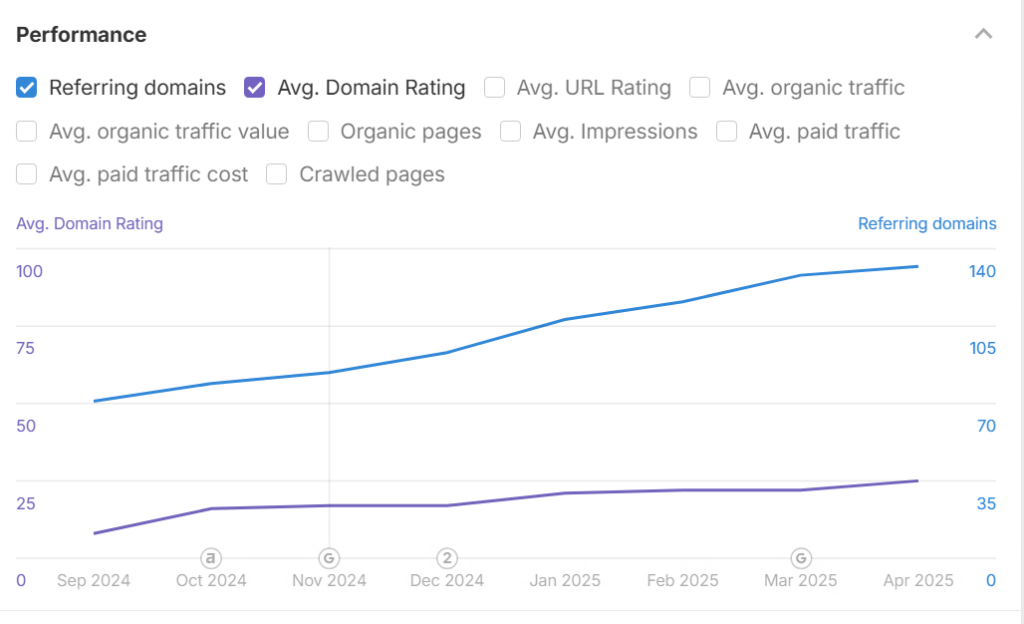
The chart illustrates the promotion of the DUMOK e-commerce store, which sells hookahs. The main challenge was that not all platforms agreed to publish content in this niche, as it is considered highly specific. This made it difficult to select high-quality donor websites for link placements.
Despite these challenges, from September 2024 to April 2025, significant results were achieved thanks to backlinks from platforms with high DR, strong traffic, and minimal outbound links. As a result, the website’s Domain Rating increased from 8 to 25.
At the initial stage, the site had backlinks from 71 domains, and by April 2025, this number had grown to 132 domains. This steady growth in quality referring domains was the key factor in boosting the DR.
Conclusion
For “gray” niches like hookahs and tobacco, the key to success is not direct selling, but presenting content with the right angle. This approach enables the acquisition of natural backlinks and brand development even under strict restrictions.
As we can see, link building in challenging niches always requires a balance of creativity, analytics, and strategic thinking. From my experience, even in niches where backlinks seem like a “luxury,” they are fully attainable with a systematic and careful approach.If you work in a difficult niche and are looking for ways to acquire high-quality backlinks, the LuxSite Digital Agency team can help develop a customized promotion strategy. We have a proven track record in promoting websites across various niches and are ready to implement solutions tailored to your business!