

Businesses invest significant amounts in advertising every month, yet without call tracking and phone call analytics, it’s impossible to understand which campaigns are actually delivering results. The BRITE-NYAMA Marketing in Transition Study shows that 65% of marketers call comparing campaign performance across different channels a “serious problem” for their business. This makes it difficult to evaluate ad effectiveness, control lead cost, and make strategic decisions about budget allocation. The absence of these tools increases the risk of wasting ad spend and makes marketing investments less transparent.
TL;DR: The Key Points
- Without call tracking, businesses don’t see the full picture of ad performance and lose out on key revenue sources.
- Companies miss an average of 22% of inbound calls, and in some cases this figure reaches 62%.
- The lack of call data distorts ROI, ROAS, and ROMI, making it harder to evaluate campaign payback.
- Call tracking links every call to a traffic source and helps identify the most effective channels.
- Combining call tracking, CRM, and call recording allows businesses to analyze lead quality and improve sales effectiveness.
- Practitioners achieve 25-35% improvement in customer acquisition cost by reallocating budget based on call tracking data.
Why Ad Budget “Leaks” Unnoticed, and Where the Money Is Actually Lost
Ad budget can leak away unnoticed due to the lack of accurate campaign performance tracking. Without call tracking, a business can’t see which channels are generating real calls and sales, and which are simply consuming resources. This leads to inefficient budget allocation, a buildup of missed calls, and difficulty evaluating ad ROI.
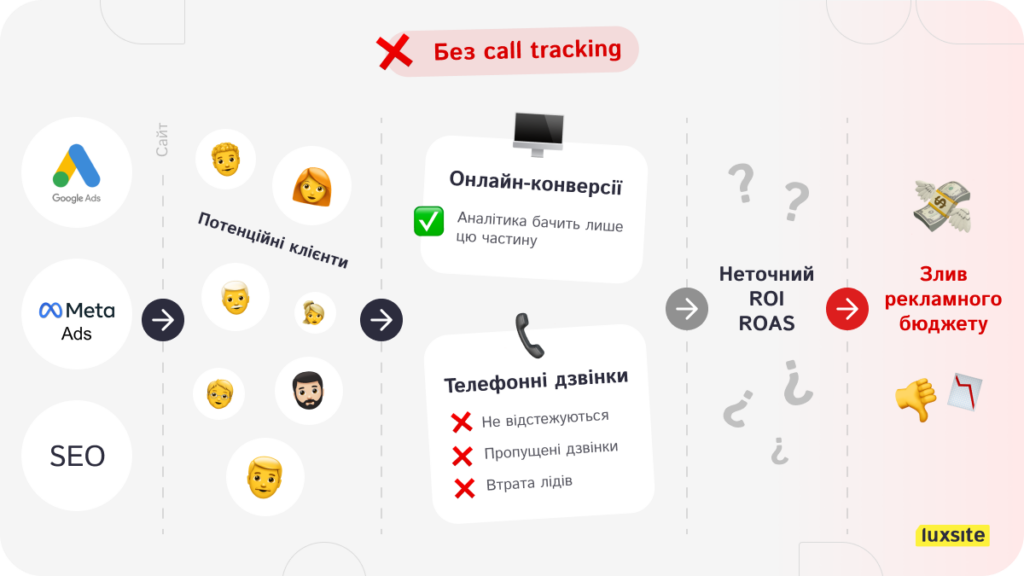
The core problem is that a phone call is a conversion too – not “something outside of analytics.” In many niches, a phone call can be a more valuable conversion than a completed web form. Customers often call to quickly check a price, product availability, terms, booking a service, a consultation, or turnaround times. This means that failing to track calls causes a business to miss the real value of these interactions and distorts advertising return metrics.
According to Invoca research, 46% of consumers stop buying from a business if their calls repeatedly go unanswered. In addition, the lack of accurate call data means a company can’t assess lead cost, allocate budget effectively, or control campaign profitability – leading to wasted spend on underperforming channels and lower marketing ROI.
The Content Marketing Institute notes that if you’re not tracking phone leads back to content and then to revenue, you’re not doing your job well. This is especially critical since inbound sales calls typically convert to revenue at a higher rate than web leads – representing a significant gap in content marketing ROI reporting.
How Call Tracking Solves the Problem and Reveals True Ad Performance
Call tracking for business is a technology that allows companies to track all inbound calls and link them to specific ad campaigns or channels. By tracking calls generated from advertising, a business can assess the real effectiveness of channels, identify which sources bring in the most customers, and get the best results for the same ad spend. In addition, phone analytics allows businesses to analyze call quality and improve how account managers handle customer interactions.
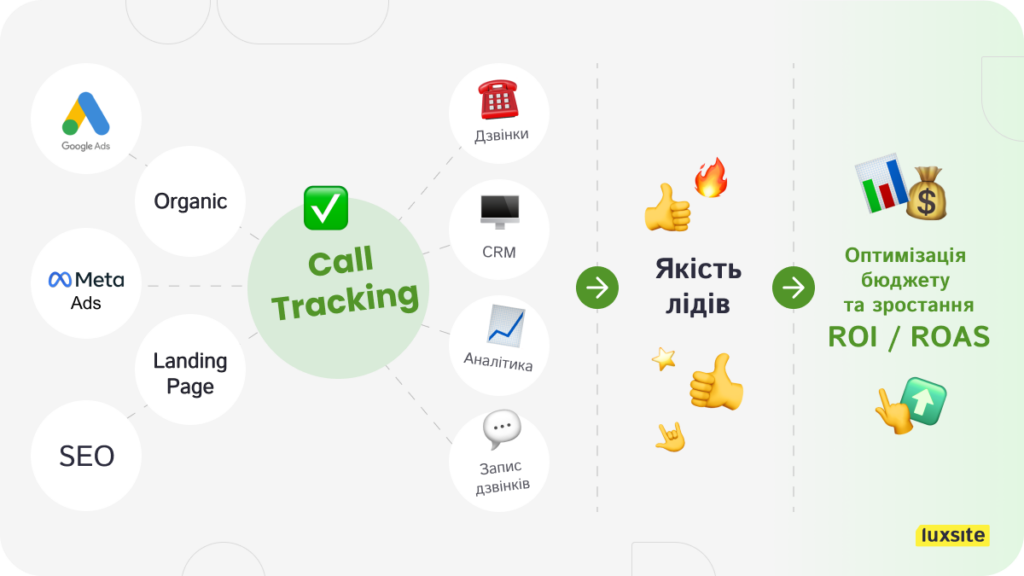
Not all calls are equally valuable: why lead quality matters. Call tracking isn’t just for counting calls – it lets you analyze their quality. This allows a business to distinguish valuable inquiries that lead directly to a sale or service booking from insignificant general information requests. Lead quality analysis helps identify which ad channels deliver the most value, optimize budget, and improve sales team performance.
Call tracking reveals the true picture of ROI, ROAS, and ROMI. These key marketing metrics determine how effectively a business uses its investments and ad budget. For these metrics to give an accurate picture of results, all conversion sources need to be accounted for, including calls and offline actions. Without call tracking, data is often distorted, making it harder to evaluate ad effectiveness.
| Metric | What It Shows | Why It’s Inaccurate Without Call Tracking |
| ROI (Return on Investment) | How much profit was generated from ad investment | Without call tracking, you only see the costs and revenue recorded in sales systems. Call and offline conversion data is missing, so ad ROI can be understated or overstated, and the company doesn’t see the true payback of its advertising. |
| ROAS (Return on Ad Spend) | Revenue generated per unit spent on advertising | Without call tracking, you only see clicks and site visits. Calls generated from ads, call duration, and lead quality aren’t factored in, so the metric doesn’t reflect the real effectiveness of channels and can be misleading about campaign profitability. |
| ROMI (Return on Marketing Investment) | Payback on all marketing investments | Without call tracking, you only see part of the marketing results: online conversions and costs. Missed calls, offline conversions, and lead quality aren’t accounted for, which distorts the true return on investment. |
Without call tracking, these metrics get distorted:
- ROI stays inaccurate, since you only see the costs and revenue recorded in sales systems. Call and offline conversion data is missing, so the real payback of advertising can be understated or overstated.
- ROAS only accounts for clicks and site visits, but doesn’t factor in calls generated from ads, call duration, or lead quality. The metric doesn’t reflect the true effectiveness of channels.
- ROMI only shows part of the marketing results (online conversions), missing out on missed calls, offline conversions, and lead quality.
Practical studies confirm the effectiveness of call tracking: practitioners achieve a 25-35% improvement in customer acquisition cost by reallocating budget. In addition, the company gets a transparent picture of customer interactions and improves the return on its advertising investment.
Integrating Call Tracking with CRM, Call Recording and Key Metrics to Track
Integrating call tracking with a CRM and call recording gives a business a complete picture of customer interactions. This approach provides accurate phone analytics, allows you to track inquiry quality, evaluate manager performance, and make informed decisions about optimizing marketing spend. Combining these tools allows you to monitor all calls and improves the effectiveness of working with potential customers.
Once call tracking is set up, it’s important to track key metrics to accurately assess the effectiveness of calls and ad channels:
- Number of calls – lets you assess the overall volume of inquiries and customer activity, though this metric should be considered alongside lead quality.
- Call duration – helps assess the level of customer engagement during the conversation and identify which calls are more likely to lead to a sale.
- Call source – shows which channels or campaigns customers are coming from, helping optimize budget allocation.
- Missed calls – allows you to quickly respond to lost potential leads and improve service.
- Lead quality – assesses which calls actually lead to a sale or service booking (this matters more than simple call volume).
- Cost per call – helps calculate the payback and return on ad investment.
- Call recording – allows you to analyze manager performance and improve how inquiries are handled by listening to and reviewing conversations.
It’s important to understand the difference between static and dynamic call tracking. Static call tracking works by assigning a separate phone number to a specific channel or campaign, and all calls through that number are attributed to it. Dynamic call tracking automatically changes the numbers displayed on the site depending on the traffic source, allowing you to track calls from different ads and channels in real time. This provides a more detailed picture of the effectiveness of each ad source and more accurately assesses the return on marketing investment.
Do you need call tracking if you already have Google Analytics on your site? Google Analytics lets you track visits and online conversions, but it doesn’t provide complete information about phone calls. Call tracking allows you to link every call to a specific traffic source, assess inquiry quality, and determine the real payback of advertising – something you can’t do with Google Analytics data alone. That’s why for businesses that get a significant share of their leads through phone calls, call tracking is a necessary addition to their analytics.
Conclusion: Without Call Tracking, Advertising Operates in the Dark
Without call tracking, a business doesn’t have complete information about which ad channels are actually generating calls and sales. This makes it harder to evaluate campaign performance, control costs, and determine the return on marketing investment. Statistics show that 82% of marketers agree that insights from inbound calls can reveal costly blind spots in their organizations.
Using call tracking makes data transparent, allows you to optimize budget, and enables informed decisions to improve ad profitability. Combining call tracking, CRM systems, and call recording provides a complete picture of customer interactions, improves service quality, and maximizes the ROI of every marketing investment. For any business that receives inquiries by phone and wants to accurately assess the effectiveness of its marketing channels, call tracking isn’t a luxury – it’s a necessity.