
According to Invoca, 67% of consumers call a company before making a purchase decision. Therefore, it’s important for businesses not only to understand how many calls their advertising generates, but also why some of them convert while others don’t.
In this article, together with Ringostat experts, we explore how to combine AI analytics and call tracking data to increase both call volume and sales.
What Call Tracking Is and How It Evolves with AI
Call tracking is a technology that uses dynamic number insertion on a website to identify which advertising sources, channels, campaigns or keywords drive incoming calls.
While traditional call tracking helped businesses see that one Google Ads campaign generated 50 calls and a Facebook campaign generated 10, for example, integrating it with AI now allows companies to dive deeper into these conversations and understand the full context of customer needs.
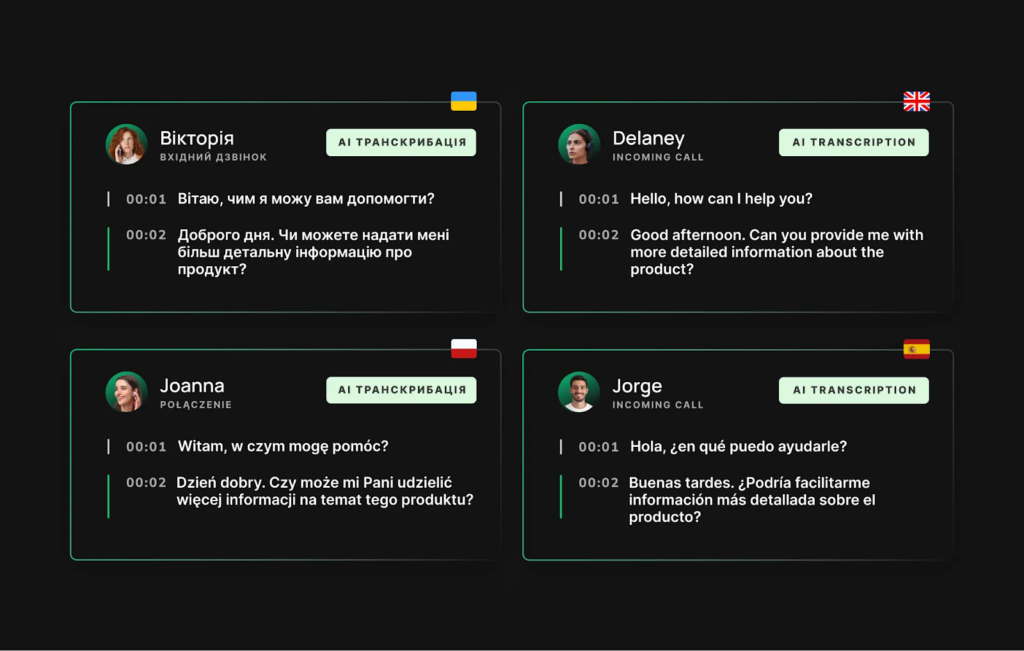
There’s no need to manually listen to call recordings – AI automatically transcribes them, creates summaries and evaluates the overall quality of communication.
How Automated Call Analysis Works: Transcription, Tone Evaluation, Topic Tagging
A supervisor typically needs 10–15 minutes to properly analyze one minute of a call recording, especially if it includes noise or unclear speech. AI does this in seconds:
- Transcription. Ringostat AI algorithms recognize over 50 languages, accounting for accents, dialects, fast speech, industry-specific terminology and even background noise, converting voice recordings into text.
- Tone evaluation. The system detects the emotional tone of both participants based on wording, intonation and pauses. Right after the call, reports show whether the customer was engaged or dissatisfied.
- Topic tagging. AI automatically identifies what the conversation was about – whether it included a discount request, a complaint or a product inquiry.
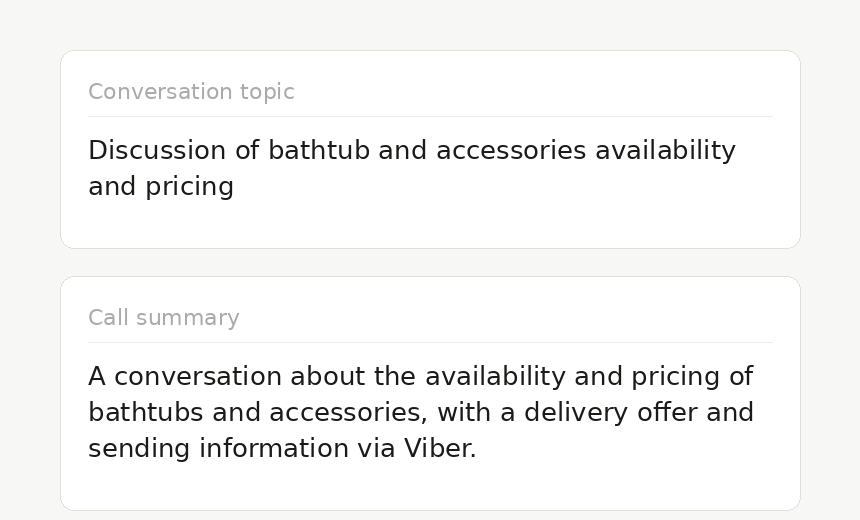
- Summaries and next steps. After the call, AI generates a brief summary and suggests follow-up actions, such as calling the customer back in two days or sending a commercial offer.
Identifying Growth Points: Lost Leads, Missed Triggers, Weak Scripts
With call tracking in Ukraine, businesses anywhere in the world can identify irrelevant calls with over 97% accuracy – for example, when users call to order a cake from a company that only offers pastry workshops.
At the same time, AI helps detect whether the support or sales team is losing leads generated by marketing. For example, managers may:
- fail to follow the conversation structure;
- mishandle objections;
- ignore trigger words indicating intent to refuse from buying;
- pause too long;
- fail to define next steps, leaving customers uncertain.
Improving scripts based on AI insights increases conversion rates. For example, if the phrase “Our courses cost 20,000 UAH” triggers responses like “I’ll think about it” or “That’s expensive,” AI may suggest reframing it as “Your investment in learning is just 100 UAH per day.” This removes price objections before they arise.
Benefits of AI and Call Tracking for Marketers and Sales Teams
For marketers, the “AI + call tracking” combination provides control over ROI, flexible budget allocation and insights into real customer motivations and behavior. Key benefits include:
- Call segmentation into qualified and unqualified leads – marketers can evaluate campaign performance not only by the number of leads, but also by whether those leads are genuinely interested in making a purchase;
- Automated customer profiling – while the conversation with a manager is ongoing, AI identifies key customer characteristics such as age, reason for inquiry, and motivation. When a business doesn’t yet fully understand its target audience or is launching a new product, these datasets can be uploaded into ChatGPT to uncover patterns;
- Hidden keyword discovery – customers often describe products differently than marketers do. AI captures these “natural” terms, enabling teams to expand their semantic core and make advertising more relevant;
- Demand analysis – for example, in conversations of a security company, the algorithm revealed that the “motion sensor” service was mentioned in every second call. As a result, marketers increased focus on it in creatives to attract more leads. Conversely, a low number of mentions may indicate the need to rethink product positioning in advertising;
- Custom report builder with 30+ parameters – including the ability to analyze ROI for specific regions.
For sales teams, AI and Call Tracking eliminate up to 71% of tasks not directly related to selling:
- CRM data entry – managers stay fully focused on the conversation without being distracted by creating customer records or taking notes;
- Automatic summaries and recommendations – right after the call, the system generates a concise summary and suggests next steps;
- Error detection – the technology identifies phrases that may push customers away and suggests replacing them with trigger phrases that help close deals;
- Conversation structure analysis – AI highlights which stages of the script were skipped or handled ineffectively and evaluates each on a five-point scale;
- Emotion analysis – the system separately identifies the mood of both the manager and the customer. This helps determine whether the issue lies in the salesperson’s communication or if the customer was already negatively настроєний before the call. If customer sentiment during conversations is mostly positive but sales are still low, the root cause may lie in the product or pricing.
Example Metrics: Channel ROI, Response Time, Keywords in Calls
AI-powered call analytics combined with call tracking enables businesses to measure not only lead volume but also lead quality.
Average response time
According to PRWeb, 60% of users won’t wait longer than a minute for an answer and will call a competitor instead. The speed at which managers respond to incoming calls can be monitored in telephony reports or directly in the CRM system.
In a LuxSite client case, a dental clinic was losing up to 28% of leads due to slow response times (average: 22 seconds). After implementing AI analytics, Ringostat call tracking and updated callback processes:
- response time dropped to 7 seconds;
- appointment bookings increased by 41% without increasing the ad budget.
Channel ROI
Thanks to the integration of call tracking with CRM systems, sales data is fed back into advertising platforms. For example, Google receives signals about which calls generated revenue and automatically optimizes ad delivery toward similar audiences.
Ringostat’s end-to-end analytics automatically calculates ROI and the cost of acquiring a qualified call, allows the use of different attribution models, and enables assigning custom weights to each conversion.
Keywords in calls
AI-powered conversation analysis is also effective for building a “live” semantic core. For example, a construction company used AI to discover that professional builders use slang terms for paints and tools that were not reflected in its advertising.
Adding these natural keywords expanded the range of search queries the company targeted and improved overall campaign performance.
Integrations with Ringostat, CRM and BI Tools
Key benefits of integrating AI and call tracking with CRM systems include:
- automatic transfer of key conversation insights into CRM;
- automatic callback tasks for missed calls (reducing missed opportunities by up to 30%);
- instant access to customer history during incoming calls.
Integration with BI tools (e.g., Owox BI) aggregates data from GA4, CRM, and call tracking systems, enabling:
- detailed analysis of call sources and costs;
- campaign contribution to sales and ROI;
- advanced reporting for deeper insights.
Integration with BI (Business Intelligence) tools works as follows: for example, Owox BI collects data from GA4 and CRM systems and enriches it with information about qualified, missed, and repeat calls.
This enables businesses to optimize advertising spend based on detailed insights into call sources, cost per inquiry, each campaign’s contribution to sales and ROI, as well as to build reports of any complexity for deeper analysis.
How AI Automates Reporting
Traditional reporting usually relies on subjective manager comments in CRM systems and selective listening to call recordings. But every marketer – just like every business owner – will choose “more revenue” over “more reports.” AI helps make that possible.
Ringostat captures every incoming lead in the call log and automatically pulls in data about the advertising source, campaign and keyword.
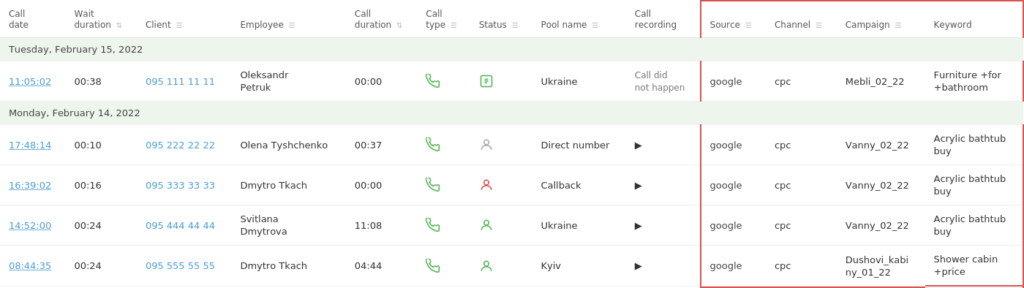
Based on this data, AI generates in-depth analytics on lead volume by source, missed calls, and manager performance. The “AI Analysis” report automatically evaluates each stage of the conversation and provides recommendations to improve sales.
The “Problematic Calls” filter highlights conversations with negative sentiment, helping prevent potential customers from churning to competitors.
The Future of Communication Analytics
AI is no longer limited to analyzing past conversations – it is now able to predict a customer’s readiness to buy.
Algorithms also combine data from calls, CRM systems, purchase history, and website behavior to build more personalized, higher-converting sales strategies.
In the near future, voice AI assistants will also take over handling routine objections, allowing managers to focus exclusively on complex, strategically important deals.
Companies that already use AI and call tracking today are successfully scaling sales while spending only a few minutes on analysis.