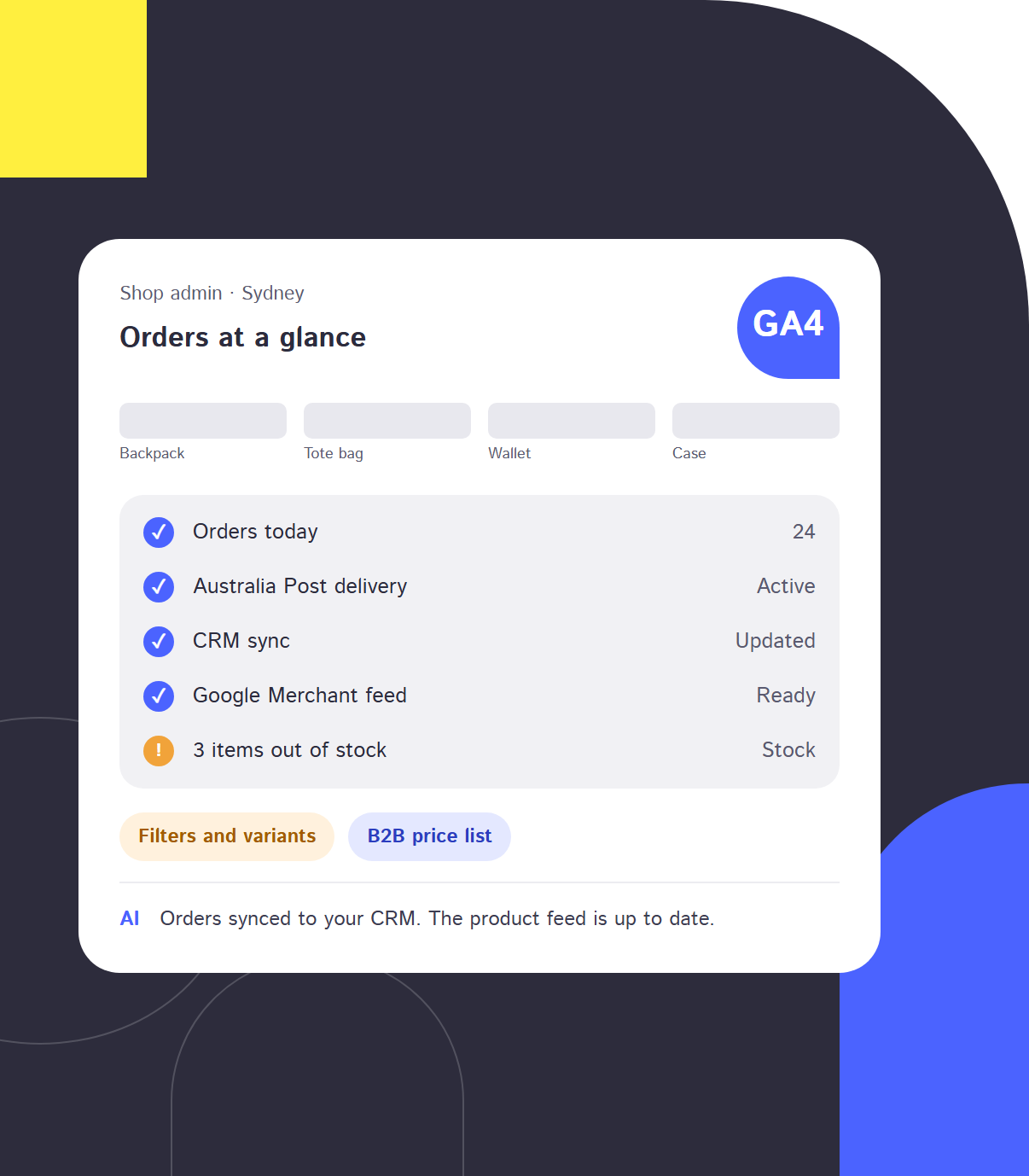
Ecommerce Website Development
We launched our first client websites back in 2010.
Developers, a designer, an SEO specialist and an ads specialist work on each project.
We look after a website for years after launch rather than handing it over and walking away.
That is the score of our own website, luxsite.agency.
Problems often stem from weak structure, slow loading speeds, or complex management.
Difficult product and price updates
In our admin panel you edit texts, prices, and catalogue items without developer help.
Slow mobile loading speeds
We optimise code and images to ensure high performance according to Core Web Vitals standards.
Platform limits your features
Our custom open-source engine gives you full development freedom and zero monthly rental fees.
No sales from search engines
We build proper SEO structure, clean URLs, schema markup, and hreflang tags before writing code.
Custom open-source website vs SaaS platform rental
Main differences between the two approaches:
SaaS rental platforms let you launch quickly, but they limit customisation and demand ongoing fees. Your own website belongs to you and grows according to your business needs.
Symfony ecommerce website
- You own the source code and database with no monthly subscription fees.
- SEO structure, clean URLs, and schema markup are planned around your goals.
- Custom integrations with CRM, ERP, payment gateways, and delivery services.
- Option to connect AI assistants via REST API and MCP.
- Fast page loading speed on mobile devices.
SaaS rental platforms
- You pay monthly rental fees and transaction commissions.
- Limited flexibility for advanced SEO optimisation and structure building.
- Difficult or impossible custom integrations with external inventory systems.
- Closed source code prevents building custom business logic.
- Your data and code remain on the SaaS provider’s servers.
We set up domain and hosting under your account. After launch, we hand over full access rights and source code ownership.
We use Claude Code and Claude Design for routine tasks. This reduces billable hours and speeds up the release.
Our in-house SEO team and ad specialists prepare your website for promotion during the planning stage.
We update the system, create backups, monitor Core Web Vitals speed, and build custom feature additions.
We deliver a sales-ready tool equipped with all essential features.
Catalog and filters
Intuitive navigation, product variants by colour or size, and fast attribute filters.
Order checkout
Simple checkout flow with choice of delivery options and online payments.
CRM synchronisation
Automated sync of orders, contacts, and statuses with KeyCRM, Odoo, Bitrix24, or HubSpot.
Shipping and payments
Integration with local couriers and postal services as well as payment gateways.
Analytics and pixels
Setup and configuration of GA4 ecommerce, Google Ads, and Meta Pixel for conversion tracking.
Product feeds
Automated feed generation for Google Merchant Center and Meta catalogue.
Multilingual setup
Support for multiple languages with correct hreflang tags for search engines.
Convenient admin panel
Ability to edit products, texts, and banners independently without developer involvement.
Types of stores we build
1
Retail store with cart and shipping
Classic online stores with easy product selection, shopping cart, online payments, and courier integration.
2
Product catalogue website without cart
Showcase website with price request or inquiry buttons instead of direct online buying.
3
B2B ecommerce website with wholesale prices
Dedicated feature set for wholesale buyers with locked wholesale prices after login and bulk price lists.
4
Store with complex product options
Smooth selection process for products with multiple attributes, sizes, colours, and configurations.
5
Multilingual international store
Full launch into international markets with separate language versions and hreflang tags.
6
Migration from other platforms
Migration from Tilda, Wix, or Joomla while preserving SEO rankings through 301 redirects.
Ecommerce website creation: LuxSite technology and approach
A successful online shop requires a reliable tech stack, clear interface design, and solid SEO structure. At digital agency LuxSite, ecommerce website development is executed with future marketing and promotion in mind. We build site architecture so every category and product page can attract organic search traffic from Google.
Core components of an online store
Every project centers on buyer convenience and simple administrative management. Our custom Symfony ecommerce LuxSite engine features open-source code under the Apache 2.0 license. This means zero monthly rental fees and total client ownership of the source code.
During planning and architecture, we implement the following features:
- Hierarchical category structure supporting landing pages for low-frequency queries.
- Fast filters by attributes, brand, and price ranges.
- Product cards with image galleries, variant selection, related product blocks, and customer reviews.
- Simple shopping cart and checkout flow with minimal form fields.
Product catalogue website and B2B pricing
Not every business requires a standard retail checkout. A product catalogue website works better for companies selling wholesale or handling complex equipment. In such cases, we replace the buy button with a price request form or request for quotation button.
For distributor networks, we build a dedicated b2b ecommerce website. After logging into their personal account, wholesale buyers see custom pricing, special tier discounts, and real-time stock levels. Clients can also quickly export product specifications and price lists in convenient formats.
Integrations: payments, shipping, CRM, and feeds
Process automation accelerates order processing and reduces workload for account managers. We connect your website to modern business tools:
- Payment systems for accepting online card payments and digital wallets.
- Delivery integrations with local couriers and postal services for automated shipping calculation and tracking.
- KeyCRM, Odoo, Bitrix24, or HubSpot systems for centralised lead and customer management.
- Automated feed generation for Google Merchant Center and Meta catalogue to power shopping campaigns and remarketing.
How we migrate websites without losing organic traffic
If you currently operate on Wix, Tilda, or Joomla, you can switch to a new platform without search ranking drops. Our SEO specialists prepare a complete 301 redirect map, preserving existing link structure and authority. Before launch, we verify metadata, schema markup, and loading performance against Core Web Vitals standards.
How we market online stores after launch is covered on the page “Comprehensive Marketing for Online Stores”.
Більше
Stages of ecommerce website development
You approve every phase step by step, and we launch the store only after full checkout and payment verification.
We gather business requirements, analyse competitors, and build a detailed SEO structure for your future store.
We design user-friendly layouts in Claude Design with full mobile responsiveness.
We write clean code with Claude Code, connecting CRM, payment systems, shipping options, and product feeds.
We check page speed, checkout flow, and third-party integrations before moving the website to your domain.
We manage backups, security updates, Core Web Vitals monitoring, and ongoing feature development.
Platforms for ecommerce website creation
We select the tech stack based on project scale, catalogue size, and required customisation flexibility.
Our full range of services
LuxSite services for end-to-end marketing:

Pricing
Landing page
from 1100 AUD
Corporate sites
from 1800 AUD
Showcase sites
from 3500 AUD
Internet stores
from 7500 AUD
Comparison of ecommerce website platforms
| Criteria | Symfony ecommerce LuxSite | WooCommerce / OpenCart | Shopify, Horoshop |
|---|---|---|---|
| Code ownership | Full intellectual property rights belong to the client | Full intellectual property rights belong to the client | Code belongs to the SaaS platform provider |
| Monthly fee | None, you only pay for your own hosting | None, you only pay for your own hosting | Mandatory monthly subscription and transaction fees |
| SEO flexibility | Complete freedom for settings and custom URLs | Good flexibility via third-party plugins | Restricted by platform system rules |
| Loading speed | No unnecessary modules, full Core Web Vitals control | Depends on number of installed plugins | Controlled entirely by provider’s servers |
| CRM integrations | Any external software via API | Most integrations via ready-made modules | Limited to platform app marketplace |
| AI connectivity | Native REST API and MCP support | Requires custom additional development | Restricted external connections |
| Code customisation | Unlimited custom build for any logic | Constrained by core CMS architecture | Impossible beyond platform boundaries |
An experienced team of professionals









How much does ecommerce website development cost?
Pricing depends on technical specification, number of integrations, and chosen platform. To provide an accurate estimate, our manager reviews your requirements for functionality, catalogue size, and design. Contact us to get a proposal for your store.
Custom engine vs SaaS platform rental: which is better?
SaaS rental platforms work well for quick market testing with minimal setup. However, a custom Symfony engine requires no monthly subscription and gives complete freedom in SEO optimisation. The code stays yours.
Will I be able to add products independently?
Yes, the admin panel is designed for easy management without programming skills. You can edit prices, product descriptions, and add new categories. We provide guides and train your team.
How to preserve SEO rankings during website migration?
Our team prepares a detailed 301 redirect mapping from old URLs to new page addresses. We preserve metadata, category hierarchy, and schema markup. This prevents loss of organic search traffic.
Which integrations can be connected to the store?
We integrate payment gateways, local couriers and postal services, as well as KeyCRM, Odoo, or Bitrix24. We also configure automated exports to Google Merchant Center and Meta catalogue.
Which platform fits best for a product catalogue website?
For websites without a direct cart, our Symfony ecommerce LuxSite engine works well for catalogue setups with wholesale pricing features. It displays products cleanly with price inquiry or wholesale quote buttons. For B2B dealers, custom price tiers unlock after login.
Who purchases the domain and hosting?
All hosting and domain accounts are registered strictly under your name. After launch, you hold full access to servers and source code. We recommend reliable hosting providers based on project needs.
What happens after the ecommerce website launch?
We offer ongoing technical support, security patches, and automated backups. Our team regularly monitors load times using Core Web Vitals standards. We also develop new features whenever your business requires.